


Over 80 percent of british organisations struggle to foster true innovation despite their best efforts. In a rapidly changing world, sticking to traditional problem-solving methods often leads to predictable results and missed opportunities. Understanding the principles of design thinking helps leaders and teams unlock fresh perspectives, sidestep common myths, and deliver solutions that connect with real human needs.
Table of Contents
- Defining Design Thinking And Common Myths
- Core Principles And Process Stages Explained
- Key Benefits For UK Businesses And Teams
- Practical Applications Across Sectors
- Comparison With Traditional Problem-Solving
- Common Mistakes And How To Avoid Them
Key Takeaways
| Point | Details |
|---|---|
| Human-Centred Approach | Design thinking prioritises user needs and experiences, making it an essential tool for innovation across various industries. |
| Iterative Process | The methodology embraces flexibility and continuous refinement, encouraging teams to test and adapt solutions dynamically. |
| Collaborative Framework | Effective design thinking requires interdisciplinary collaboration, breaking down silos to create more holistic solutions. |
| Transformative Benefits | Implementing design thinking enhances organisational adaptability and fosters a culture of innovation, leading to sustainable growth. |
Defining Design Thinking and Common Myths
Design thinking represents a revolutionary approach to problem-solving that transcends traditional methodologies. According to research from mdpi.com, it is a human-centred approach to innovation that strategically integrates three critical dimensions: human needs, technological possibilities, and business requirements.
Contrary to popular misconceptions, design thinking is not confined to product design or limited to professional designers. Arxiv.org highlights that this methodology is a flexible, collaborative process involving stakeholders from diverse backgrounds. It challenges the traditional linear problem-solving approach by embracing an iterative framework that allows continuous refinement of ideas.
The key characteristics of design thinking include:
- Human-centred focus: Prioritising genuine user experiences and needs
- Interdisciplinary collaboration: Breaking down traditional departmental silos
- Iterative problem-solving: Continuously testing, learning, and adapting solutions
- Empathy-driven approach: Understanding deeper context beyond surface-level observations
Understanding these nuanced aspects helps business professionals recognise design thinking as a powerful strategic tool applicable across industries. Whether you are developing a new service, reimagining customer experience, or tackling complex organisational challenges, this approach offers a structured yet creative pathway to meaningful innovation.
Core Principles and Process Stages Explained
Design thinking is a structured yet creative approach that follows specific principles and stages designed to generate innovative solutions. According to research from mdpi.com, the core principles encompass multidisciplinary collaboration, user-centred approach, creative problem solving, and an iterative methodology that encourages continuous learning and adaptation.
The process typically unfolds through five interconnected stages that form a dynamic problem-solving framework. Indeed.co.uk outlines these stages as a systematic journey of discovery and innovation:
- Empathise: Deep exploration of user experiences and perspectives
- Define: Crystallising insights into a clear, actionable problem statement
- Ideate: Generating diverse, creative potential solutions
- Prototype: Creating tangible, experimental versions of solutions
- Test: Gathering feedback and refining approaches
Key guiding principles that underpin this approach include the human rule (design is inherently social), the ambiguity rule (embracing uncertainty as an opportunity), the redesign rule (recognising that all design builds on previous iterations), and the tangibility rule (making ideas concrete and testable).
 These principles transform design thinking from a mere methodology into a holistic approach for addressing complex challenges across business, technology, and social domains.
Key Benefits for UK Businesses and Teams
Design thinking offers transformative advantages for UK businesses seeking to enhance their competitive edge and organisational capabilities. According to Indeed.co.uk, this approach fosters innovative problem-solving by encouraging a human-centric methodology that directly aligns business strategies with genuine customer needs.
The methodology generates significant organisational benefits, particularly in team dynamics and strategic development. Research from mdpi.com highlights that design thinking can drive sustainable innovation by creating alignment with broader business objectives and emerging market demands. When implemented effectively, it transforms traditional workplace approaches into more adaptive, collaborative environments.
Key benefits for UK businesses include:
- Enhanced Collaboration: Breaking down departmental silos
- Customer-Centric Innovation: Developing solutions directly informed by user experiences
- Rapid Prototyping: Reducing time and resources spent on unvalidated concepts
- Organisational Adaptability: Creating more flexible, responsive business models
Implementing design thinking is particularly powerful for UK small businesses and sustainable business strategies, offering a structured yet creative approach to addressing complex challenges. By prioritising empathy, iteration, and user-centred solutions, organisations can develop more meaningful, impactful strategies that resonate with both internal teams and external stakeholders.
Practical Applications Across Sectors
Design thinking demonstrates remarkable versatility in addressing complex challenges across diverse industry landscapes. According to research from mdpi.com, the methodology has proven particularly effective in sectors such as healthcare, education, and technology, where user-centred solutions can dramatically transform traditional approaches to problem-solving.
The Attitude, Aptitude, and Amplitude (AAA) framework, as explored in arxiv.org research, illuminates how design thinking drives innovation across manufacturing and service industries by cultivating a culture of creativity and user-focused design. This approach enables organisations to move beyond conventional thinking and develop more responsive, intuitive solutions that directly address stakeholder needs.
Practical applications span multiple domains:
- Healthcare: Redesigning patient experiences and medical workflows
- Education: Creating more engaging learning environments and personalised educational tools
- Technology: Developing intuitive user interfaces and customer-centric digital solutions
- Manufacturing: Streamlining production processes and enhancing product design
- Financial Services: Reimagining customer journey and developing more accessible financial products
With 7 essential small business tax tips in mind, design thinking can also help businesses navigate complex regulatory landscapes by providing a structured yet flexible approach to understanding and addressing systemic challenges across various professional contexts.
Comparison With Traditional Problem-Solving
Traditional problem-solving methodologies typically rely on linear, analytical approaches that prioritise predictability and incremental optimisation. According to research from Arxiv.org, design thinking represents a fundamental departure from this conventional model, emphasising iterative exploration and deep understanding of user experiences rather than rigid, predetermined solutions.
The fundamental distinction lies in the approach to problem definition and solution generation. Wikipedia highlights that traditional methods often focus on refining existing solutions, whereas design thinking seeks to expand the conceptual landscape by exploring novel knowledge domains and challenging established assumptions. This approach transforms problem-solving from a restrictive, linear process into a dynamic, creative journey of discovery.
Key differences between traditional and design thinking approaches include:
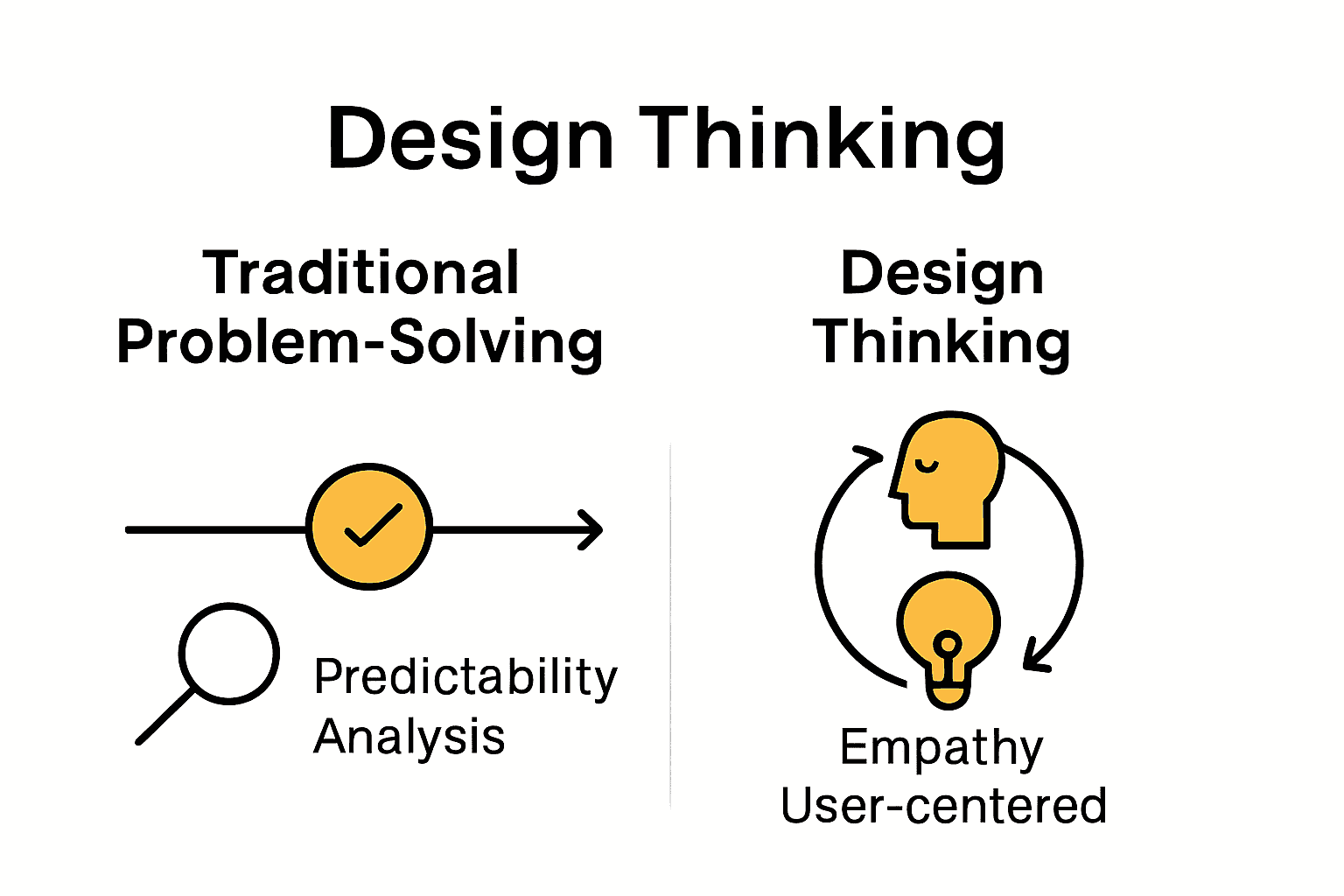
- Problem Framing: Traditional approaches define problems narrowly; design thinking reframes challenges holistically
- Solution Development: Linear optimisation versus exploratory, iterative creation
- User Engagement: Peripheral consideration versus central, empathetic understanding
- Innovation Potential: Incremental improvements versus transformative solutions
For businesses seeking to navigate complex challenges, 7 essential small business tax tips demonstrate how adaptive thinking can provide more nuanced, creative approaches to seemingly rigid problems. Design thinking offers a more flexible, human-centred alternative to traditional problem-solving, enabling organisations to uncover insights and opportunities that conventional methods might overlook.
Common Mistakes and How to Avoid Them
Design thinking is a nuanced methodology that requires careful implementation to unlock its full potential. According to research from Arxiv.org, one of the most significant pitfalls is treating design thinking as a rigid, linear process, when in reality it demands a flexible, iterative approach that allows continuous refinement and adaptation.
Another critical challenge organisations encounter involves cultivating the right organisational culture. Arxiv.org emphasises that design thinking requires collaborative environments that genuinely support creativity and user-centric design, moving beyond superficial innovation rhetoric to create meaningful, systemic change.
Common mistakes to avoid include:
- Treating Design Thinking as a Checklist: Mistaking it for a prescriptive, step-by-step procedure
- Insufficient User Research: Relying on assumptions instead of deep, empathetic understanding
- Lack of Psychological Safety: Failing to create environments where teams feel comfortable experimenting
- Premature Convergence: Settling on initial solutions too quickly
- Neglecting Diverse Perspectives: Not including varied stakeholder viewpoints
For businesses seeking practical guidance, 7 essential small business tax tips demonstrate how adaptive thinking can transform seemingly complex challenges. Successful design thinking requires embracing uncertainty, maintaining curiosity, and creating spaces where creative problem-solving can genuinely flourish.
Transform Your Business Innovation with Design Thinking and KefiHub
Unlocking the full potential of design thinking means overcoming common challenges like treating it as a checklist, overcoming premature solution convergence and fostering true empathy-driven collaboration. If your organisation seeks to break down silos, embrace iterative problem-solving and drive customer-centric innovation, KefiHub offers clear, practical guidance tailored for UK businesses. We understand the pressure to innovate while aligning with real customer needs and emerging market demands.
Explore expert insights and actionable advice at KefiHub to help you apply design thinking principles effectively. Start building adaptable business models that generate sustainable innovation, enhance team dynamics and create meaningful, user-focused solutions today. Don’t let traditional methods hold you back — visit KefiHub now and take the first step towards transforming your approach to problem-solving with our trusted UK-based resources.
Frequently Asked Questions
What is design thinking?
Design thinking is a human-centred approach to innovation that combines human needs, technological possibilities, and business requirements. It encourages iterative exploration and collaboration among diverse stakeholders to create impactful solutions.
How does design thinking differ from traditional problem-solving methods?
Unlike traditional methods that focus on linear and analytical approaches, design thinking emphasises iterative exploration, holistic problem framing, and deep user engagement. It seeks to expand conceptual boundaries rather than merely refining existing solutions.
What are the main stages of the design thinking process?
The design thinking process typically unfolds in five stages: Empathise (understanding user experiences), Define (articulating the problem), Ideate (generating creative solutions), Prototype (creating tangible versions of solutions), and Test (gathering feedback and refining solutions).
What are the benefits of implementing design thinking in a business?
Implementing design thinking can enhance collaboration, foster customer-centric innovation, reduce the time spent on unvalidated concepts, and increase organisational adaptability, leading to more meaningful and impactful business strategies.
Recommended
- How to Choose the Best UK Digital Design Studio: AI vs Traditional Approach Compared – Kefihub
- Every business problem feels smaller when you understand it. We’re here to make the complex simple, one guide at a time. – Kefihub
- Business As Service Guide: Unlocking Value in 2025 – Kefihub
- 7 Key Design Trends 2025 for UK Professionals Explained – Kefihub
- FAANG interviews – ParakeetAI
- Role of Website Design: Complete Guide for Businesses – Lind Creative