


Running a small business in the United Kingdom can feel like steering through unpredictable waters when every decision counts. Performance metrics do more than track progress—they reveal strengths and weaknesses for actionable choices. By using Key Performance Indicators to measure growth, customer value, efficiency, and financial health, you gain insights that help clarify your next steps. This guide helps you discover which KPIs matter and how to use them to create real results for your business.
Table of Contents
- KPIs In Business Explained – Definition And Impact
- Major KPI Types For Small Businesses
- Choosing Effective KPIs To Match Goals
- Tracking KPIs – Tools And Practices
- Common KPI Pitfalls To Avoid
Key Takeaways
| Point | Details |
|---|---|
| Understanding KPIs is crucial | Key Performance Indicators guide businesses in measuring performance against strategic objectives. |
| Focus on SMART metrics | Choose Specific, Measurable, Achievable, Relevant, and Time-bound KPIs to ensure meaningful insights. |
| Regular reviews are essential | Conduct quarterly assessments of KPIs to maintain relevance and alignment with business goals. |
| Avoid common pitfalls | Identifying and correcting measurement missteps ensures KPIs provide actionable insights and drive success. |
KPIs in Business Explained – Definition and Impact
Key Performance Indicators (KPIs) are the strategic compass that guides businesses towards their most critical objectives. Quantifiable metrics capturing organisational performance, KPIs transform complex business data into actionable insights that drive growth and strategic decision-making.
At their core, KPIs represent measurable values that demonstrate how effectively a company is achieving key business targets. These indicators provide a snapshot of organisational health across multiple dimensions:
- Financial Performance: Revenue growth, profit margins, return on investment
- Operational Efficiency: Productivity rates, cost per unit, process completion times
- Customer Satisfaction: Net Promoter Score, customer retention rates, service response times
- Employee Engagement: Staff turnover, training completion rates, performance review outcomes
Businesses leverage KPIs to track progress, identify improvement areas, and make data-driven decisions. Leading and lagging indicators help organisations predict and assess performance across different strategic timeframes.
Successful KPI implementation requires careful selection, regular monitoring, and alignment with overarching business strategies. Not all metrics are created equal – the most impactful KPIs are specific, measurable, achievable, relevant, and time-bound (SMART).
Pro tip: Begin by identifying three to five critical KPIs directly tied to your most important business objectives, ensuring they provide clear, actionable insights into your organisational performance.
Major KPI Types for Small Businesses
Small businesses require strategic Key Performance Indicators (KPIs) that provide actionable insights into their organisational health and growth potential. Tailored KPIs help enterprises track performance across critical business dimensions and make informed strategic decisions.
Effective KPI tracking for small businesses typically encompasses four primary categories:
-
Financial KPIs
- Revenue growth
- Profit margins
- Cash flow
- Return on investment (ROI)
-
Customer-Related KPIs
- Customer acquisition cost
- Customer lifetime value
- Net Promoter Score
- Customer retention rate
-
Operational KPIs
- Productivity rates
- Process efficiency
- Cost per unit
- Project completion times
-
Employee Performance KPIs
- Staff turnover rate
- Training completion percentage
- Individual productivity
- Performance review outcomes
Small and medium enterprises leverage these KPI types to align strategic objectives with measurable outcomes. The key is selecting indicators that directly reflect your business’s unique goals and growth stage.
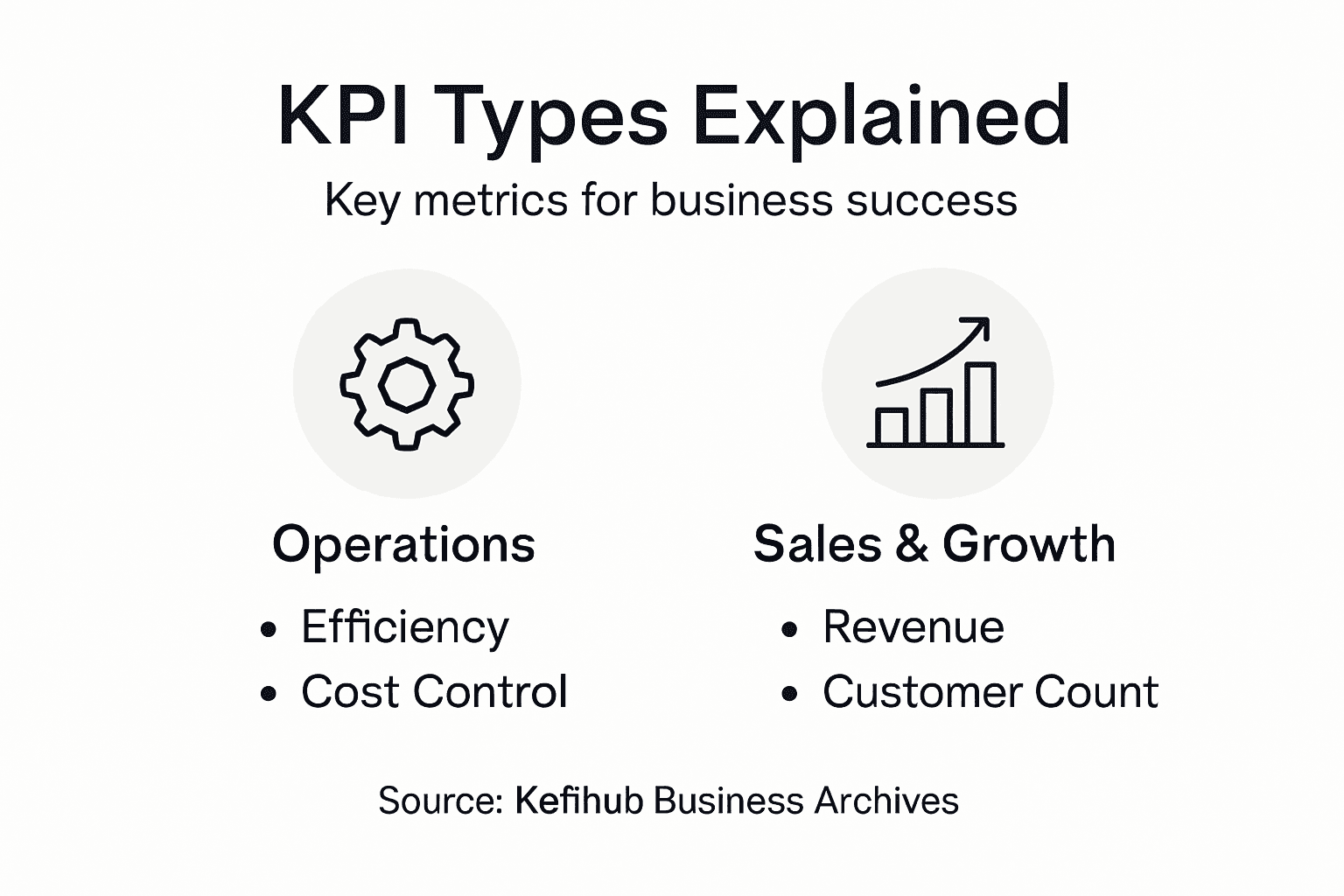
Here’s how four primary KPI categories differ in focus and business value:
| KPI Category | Main Focus | Typical Metric Example | Business Value |
|---|---|---|---|
| Financial KPIs | Profitability & growth | Cash flow, ROI | Tracks financial health |
| Customer KPIs | Client relationships | Net Promoter Score | Gauges retention & loyalty |
| Operational KPIs | Process efficiency | Cost per unit | Improves workflow efficiency |
| Employee Performance | Workforce engagement | Training completion rate | Enhances team capability |
Successful KPI implementation requires consistent monitoring, regular review, and a willingness to adapt metrics as your business evolves. Not all indicators will be equally relevant – focus on those that provide genuine insight into your performance and potential.

Pro tip: Conduct a quarterly review of your chosen KPIs, removing or adjusting metrics that no longer provide meaningful insights into your business performance.
Choosing Effective KPIs to Match Goals
Selecting the right Key Performance Indicators (KPIs) is a strategic process that demands careful consideration and alignment with your business’s core objectives. Identifying measurable indicators that reflect genuine progress requires a systematic and thoughtful approach.
To choose effective KPIs, businesses should follow a structured methodology:
-
Define Clear Strategic Objectives
- Establish specific business goals
- Determine desired outcomes
- Identify critical success factors
-
Apply the SMART Framework
- Specific: Precise and unambiguous
- Measurable: Quantifiable and trackable
- Achievable: Realistic and attainable
- Relevant: Directly connected to business goals
- Time-bound: With clear timeframes
-
Select Relevant KPI Candidates
- Assess potential indicators
- Evaluate data collection feasibility
- Consider industry benchmarks
- Prioritise indicators with direct impact
Involving cross-functional teams in KPI selection enhances accountability and ensures comprehensive perspective. Different departments can provide unique insights into meaningful performance metrics.
Successful KPI implementation is an iterative process. Regular review and adaptation prevent metric stagnation and maintain alignment with evolving business strategies. Not all indicators will remain relevant indefinitely – continuous assessment is crucial.
Effective KPIs are living tools that grow and change with your business, providing clear insights into performance and potential.
Pro tip: Schedule quarterly KPI review meetings to assess metric relevance, collect team feedback, and make necessary adjustments to your performance tracking approach.
Tracking KPIs – Tools and Practices
Key Performance Indicator (KPI) tracking demands strategic approaches that transform raw data into meaningful business insights. Defining a focused set of measurable indicators enables businesses to monitor performance effectively and drive continuous improvement.
Effective KPI tracking requires a comprehensive toolkit and systematic practices:
Digital Tracking Tools:
-
Spreadsheet Software
- Microsoft Excel
- Google Sheets
- Customisable dashboard capabilities
- Easy data manipulation
-
Dedicated KPI Dashboards
- Real-time performance visualisation
- Automated data integration
- Graphical trend analysis
- Cross-departmental reporting
-
Business Intelligence Platforms
- Advanced analytics
- Predictive modelling
- Comprehensive reporting
- Integrated data sources
Tracking Best Practices:
- Establish Clear Measurement Protocols
- Select Relevant, Actionable Metrics
- Implement Regular Review Cycles
- Ensure Data Accuracy and Consistency
- Create Accessible Reporting Mechanisms
Successful KPI tracking is not just about collecting data, but interpreting it meaningfully. Businesses must develop a culture of data-driven decision-making, where metrics inform strategy and highlight potential improvements.
Effective KPI tracking transforms numbers into strategic insights, guiding businesses towards sustainable growth and performance excellence.
Pro tip: Invest in staff training to ensure consistent data collection and interpretation, making KPI tracking a collaborative organisational effort.
Common KPI Pitfalls to Avoid
Key Performance Indicator (KPI) implementation is fraught with potential missteps that can undermine business performance and strategic planning. Identifying and avoiding common measurement traps is crucial for maintaining meaningful and actionable performance insights.
Businesses frequently encounter several critical KPI management challenges:
Major KPI Implementation Pitfalls:
-
Measuring Activities Instead of Outcomes
- Tracking process steps
- Neglecting actual business impact
- Focusing on busy work
- Ignoring strategic results
-
Quantity Over Quality of Metrics
- Excessive number of indicators
- Complex, unmanageable dashboards
- Information overload
- Diluted strategic focus
-
Data Integrity and Manipulation Risks
- Inconsistent data collection
- Potential reporting bias
- Lack of robust verification mechanisms
- Selective performance representation
Strategic Misalignment Indicators:
- Short-term Target Obsession
- Disconnected Departmental Metrics
- Ignoring Long-term Strategic Goals
- Lack of Regular Performance Review
- Minimal Stakeholder Engagement
Poor KPI management can lead to significant organisational misalignment and wasted resources. Businesses must cultivate a nuanced, strategic approach to performance tracking that goes beyond superficial metric collection.
See common pitfalls in KPI management and recommended corrective strategies:
| Pitfall | Impact on Business | How to Correct |
|---|---|---|
| Measuring activities, not outcomes | Misleads strategy, wastes resources | Shift focus to strategic results |
| Excessive metrics used | Causes data overload | Prioritise impactful indicators |
| Inconsistent data collection | Undermines decision-making | Implement strict protocols |
| Metrics misaligned with strategy | Causes organisational confusion | Align KPIs with long-term goals |
Effective KPI management is not about counting everything, but about measuring what truly matters to your business’s success.
Pro tip: Implement a quarterly KPI audit to critically assess each indicator’s relevance, ensuring your performance tracking remains dynamic and strategically aligned.
Master Your Business Growth with Clear and Smart KPI Choices
Understanding which Key Performance Indicators to track can feel overwhelming but it is essential to avoid common pitfalls like focusing on activities instead of outcomes or drowning in too many metrics. This article highlights the importance of choosing SMART KPIs that truly drive your business forward and align with your strategic goals. If you want to transform these insights into practical actions tailored for UK businesses, KefiHub offers expert guidance designed to help small business owners and professionals like you navigate these challenges with confidence.

Explore our Business Archives – Kefihub for in-depth advice and real-world stories that illustrate effective KPI implementation. Start making smarter, data-driven decisions today at KefiHub and ensure your performance tracking is not just measurement but a clear path to growth. Don’t wait until inefficiencies hold back your progress take the first step now and unlock your business’s true potential.
Frequently Asked Questions
What are Key Performance Indicators (KPIs)?
Key Performance Indicators (KPIs) are measurable values that demonstrate how effectively a company is achieving its key business objectives. They provide insights into various aspects of organisational health, such as financial performance, customer satisfaction, operational efficiency, and employee engagement.
How do I choose the right KPIs for my business?
To select effective KPIs, start by defining clear strategic objectives, apply the SMART framework (Specific, Measurable, Achievable, Relevant, Time-bound), and involve cross-functional teams to gather insights. Focus on indicators that align directly with your business goals and growth stage.
What are some common pitfalls in KPI implementation?
Common pitfalls include measuring activities instead of outcomes, having too many metrics leading to data overload, and misalignment with long-term strategic goals. It’s important to avoid these traps to ensure effective KPI management and meaningful performance insights.
How can I effectively track KPIs?
Effective KPI tracking can be achieved through the use of digital tracking tools like spreadsheet software, KPI dashboards, and business intelligence platforms. Establish clear measurement protocols, select actionable metrics, and implement regular review cycles for optimal performance monitoring.
Recommended
- Key Business Metrics Explained: Driving UK Growth – Kefihub
- Role of Analytics in Growth: UK SME Impact – Kefihub
- Business Intelligence: Empowering UK Small Businesses – Kefihub
- Growth Hacking Explained: Driving UK Business Success – Kefihub
- Wichtige Kennzahlen im Kundenservice – Hebel für Effizienz und Kundenzufriedenheit | aLIVE Support
- IT-baserade affärsfördelar för företag i Stockholm