


Running a small business in the United Kingdom means juggling endless demands while trying to stay ahead in a fast-changing market. As technology and customer needs shift, helping your team grow is no longer optional—it is what keeps your business resilient and sets you apart. Focusing on upskilling existing employees offers a powerful way to build skills, boost confidence, and prepare your business for whatever comes next.
Table of Contents
- Upskilling Your Team: What It Means
- Types Of Upskilling And Core Approaches
- Key Benefits For Small Businesses In The UK
- Practical Strategies To Upskill On A Budget
- Common Barriers And Risks To Avoid
Key Takeaways
| Point | Details |
|---|---|
| Upskilling Enhances Capability | Investing in current employees develops their skills, leading to improved adaptability and productivity as job requirements evolve. |
| Strategic Approach Required | Effective upskilling focuses on targeted skill development that aligns with business goals, rather than generic training for all employees. |
| Cost-Effective Solution for Recruitment | Upskilling reduces reliance on external hiring by nurturing existing talent, saving recruitment costs and increasing employee retention. |
| Continuous Learning is Essential | Maintaining a culture of ongoing education not only improves performance but also enhances employee satisfaction and engagement. |
Upskilling Your Team: What It Means
Upskilling is straightforward: it’s about helping your employees develop and improve the skills they already have. Rather than hiring new people for every changing role, you invest in making your current team stronger and more capable.
Upskilling improves existing employee skills to help them adapt as job requirements shift and technology evolves. It’s a continuous learning process that enhances both personal and professional capabilities, keeping your team relevant and productive.
For small business owners, this means something tangible: your plumber learns advanced diagnostics software. Your admin worker masters new accounting tools. Your marketing assistant picks up data analysis skills. These aren’t entirely new career paths—they’re natural extensions of what your team already does.
Why This Matters Right Now
The job market has changed dramatically. A role that required one skill set five years ago now demands something different. Digital transformation moves fast. Social changes reshape how work happens. Without upskilling, your team falls behind, and you’re forced to recruit externally every time demands shift.
Upskilling maintains innovation and competitiveness by preparing employees for emerging tasks and challenges. Organisations that invest in updating their workforce respond faster to market changes and stay ahead of competitors.
Here’s what upskilling really accomplishes:
- Keeps your existing team productive as work evolves
- Reduces the cost and hassle of external recruitment
- Builds employee confidence in new responsibilities
- Creates pathways for career progression within your business
- Strengthens your organisation’s ability to adapt to change
The Real Difference
Upskilling is not the same as training everyone on every tool. It’s strategic. It’s targeted. It focuses on skills that directly benefit your business and your employees’ roles.
Think of it as maintenance for your team’s capabilities. Just as your equipment needs regular updates to function properly, your workforce needs continuous learning to remain effective.
Upskilling is a continuous process, not a one-time event. Regular investment in employee development pays dividends through improved performance, innovation, and retention.
Pro tip: Start by identifying one skill gap in your team that directly impacts revenue or service delivery. Focus your upskilling efforts there first, measure the results, then expand to other areas.
Types Of Upskilling And Core Approaches
Upskilling isn’t one-size-fits-all. Different team members need different types of development depending on their roles, ambitions, and what your business needs most. Understanding the main categories helps you invest your budget wisely.
Three Core Types of Upskilling
Technical skills, soft skills, and digital literacy form the foundation of most upskilling programmes. Each addresses a different part of your team’s capability.
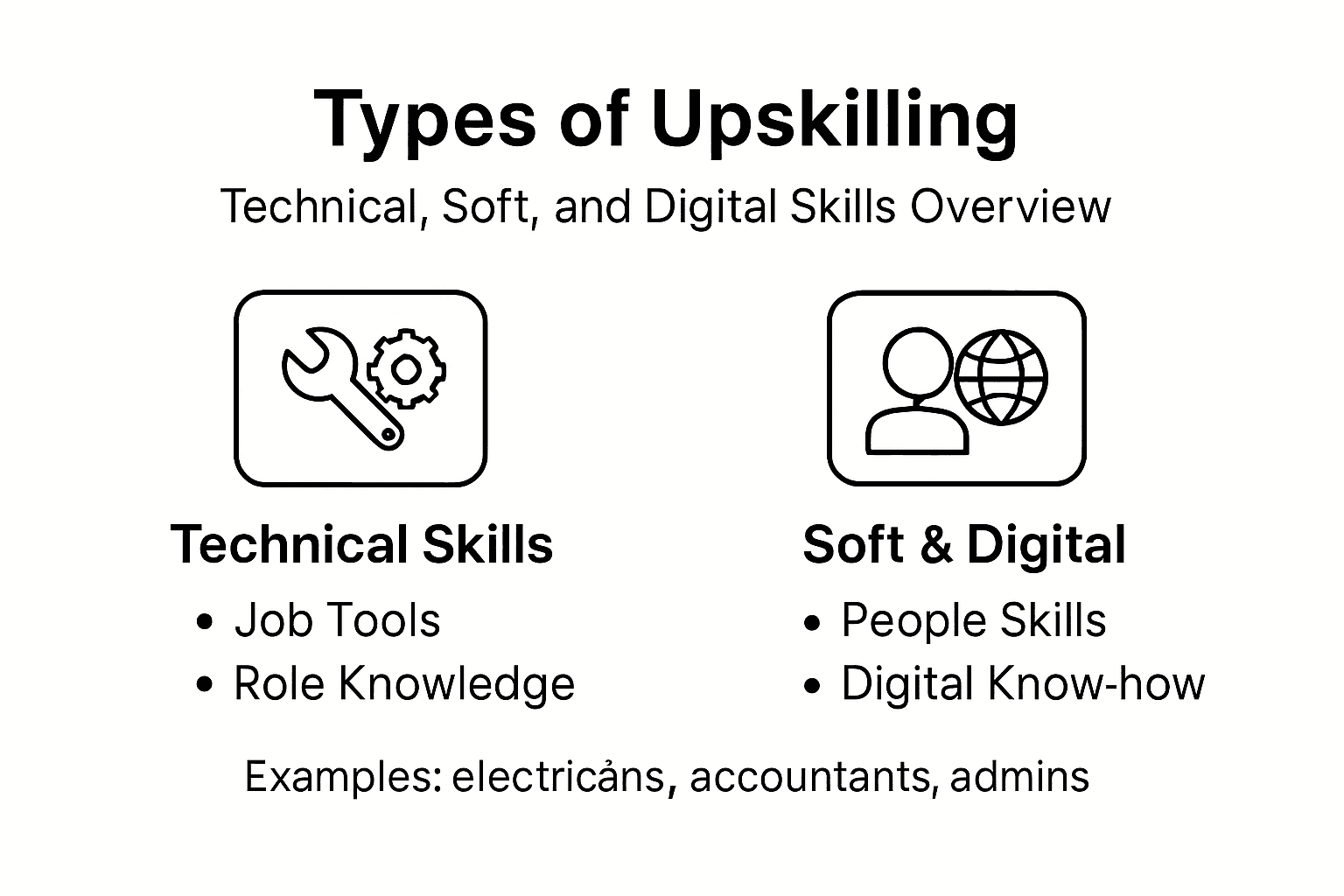
Technical skills are role-specific abilities. Your electrician needs to understand smart home systems. Your accountant needs to master cloud-based software. Your engineer needs knowledge of new machinery.
Soft skills cover how people work together. Communication, problem-solving, adaptability, and collaboration matter more than ever. These skills help your team navigate change and work effectively with clients and each other.
Digital literacy is increasingly non-negotiable. Your team needs basic confidence with digital tools, data handling, and online systems. It’s no longer optional—it’s foundational for almost every role.
To further clarify the core types of upskilling, here is a concise comparison overview:
| Upskilling Type | Target Skills | Example Roles | Typical Outcomes |
|---|---|---|---|
| Technical Skills | Role-specific expertise | Electrician, Accountant | Improved job efficiency |
| Soft Skills | Communication, teamwork | Manager, Admin staff | Stronger collaboration |
| Digital Literacy | Confidence with digital tools | Marketing assistant, Engineer | Adaptability to technology |
Effective Learning Approaches
You have several proven methods to deliver upskilling. Mix and match based on your team’s learning preferences and your constraints.
- Formal education: Accredited courses, university programmes, or certified qualifications
- On-the-job learning: Hands-on training while performing actual work tasks
- Mentorship: Pairing experienced staff with those developing skills
- Continuous professional development: Structured, ongoing learning integrated into work routines
- Modular learning: Short, focused courses on specific topics rather than lengthy programmes
Personalised training paths and emerging educational technologies allow you to adapt learning to each person’s current level and future goals. What works for your 22-year-old apprentice differs from what suits your 15-year veteran.
Selecting What Your Team Needs
Start by asking yourself: what skills gaps are holding us back? Are sales staff struggling with new CRM software? Are your managers lacking leadership training? Does everyone need better communication skills?
Align your upskilling choices with both business priorities and individual career interests. When people see a path forward within your organisation, they stay longer and perform better.
Effective upskilling programmes connect skill-building directly to workforce planning and individual growth. Strategic alignment ensures relevance, engagement, and measurable results.
Pro tip: Offer your team choice in how they learn. Some prefer online courses, others learn better through mentorship or workshops. Survey your team about their preferred learning methods, then build options around those preferences.
Key Benefits For Small Businesses In The UK
Upskilling isn’t just feel-good management theory. It delivers concrete, measurable results that directly impact your bottom line. For UK small businesses specifically, the case is compelling and backed by real data.
Boosting Productivity and Performance
When your team gains new skills, they work faster and more effectively. Upskilling delivers productivity gains estimated between 6 to 12 percent for UK employees. That’s not marginal—that’s meaningful improvement.
A skilled team completes projects faster, makes fewer errors, and requires less supervision. Your electrician with updated knowledge finishes jobs more efficiently. Your bookkeeper with better software skills processes accounts in half the time.
Retaining Your Best People
Your best employees will leave if they see no growth path. Staff loyalty and retention improve dramatically when people know you’re investing in their futures. Employees gain job satisfaction through learning opportunities, directly reducing costly turnover.

Replacing someone costs time, money, and productivity disruption. When you upskill instead, you keep experienced people who already understand your business culture and client relationships.
Tackling the UK Recruitment Challenge
Finding skilled staff is notoriously difficult in the UK right now. Rather than competing for scarce talent, upskilling lets you develop capabilities from within. This approach reduces your reliance on external hiring and addresses recruitment difficulties that plague smaller firms.
You’re working with people who already know your systems, your standards, and your expectations.
Building Resilience and Adaptability
Markets shift. Technology changes. New competitors emerge. Teams with diverse, updated skills navigate change confidently. 71 percent of UK SMEs plan to invest in upskilling, recognising this as essential for survival and growth.
Your business becomes more resilient and better positioned to seize new opportunities when your team can adapt quickly.
The Real Financial Picture
Reducing staff turnover saves significant money. Avoiding expensive external recruitment saves more. Increased productivity delivers additional revenue. The maths works in your favour.
Upskilling costs less than hiring replacement staff while delivering higher quality performance across your entire operation.
Here’s what upskilling accomplishes:
- Increases team productivity and output quality
- Reduces staff turnover and recruitment costs
- Improves customer satisfaction through better service
- Builds internal expertise and institutional knowledge
- Strengthens your competitive position in local markets
- Creates a positive workplace culture
Upskilling addresses multiple business challenges simultaneously. You’re solving recruitment problems, improving retention, boosting productivity, and building resilience—all through one strategic investment.
Pro tip: Track the financial impact of upskilling by measuring staff turnover rates and productivity metrics before and after your programme. This data becomes powerful evidence when planning future training budgets.
Practical Strategies To Upskill On A Budget
Budget constraints are real, especially for small businesses juggling multiple demands. The good news? You don’t need a six-figure training budget to develop your team effectively. Smart, targeted approaches deliver results without breaking the bank.
Start With Free and Low-Cost Resources
Utilising free or low-cost online learning platforms is one of the fastest ways to begin. Platforms like YouTube, LinkedIn Learning (often free through libraries), Coursera, and Khan Academy offer thousands of courses at minimal cost.
Your team member can learn project management, Excel skills, or communication techniques without spending anything. Many free options include certificates upon completion, which boosts employee motivation.
Tap Into Internal Knowledge
Your experienced staff already possess valuable skills. Knowledge-sharing between employees costs nothing and builds team cohesion simultaneously. A senior electrician mentoring a junior, your accounts manager coaching others in client relations—these are powerful learning moments.
Formalise this by creating peer mentoring pairs or lunch-and-learn sessions where knowledgeable staff share expertise.
Integrate Learning Into Daily Work
Don’t treat upskilling as something separate from actual work. Weave it in. Your team learns faster and applies knowledge immediately when learning happens on the job.
When implementing new software, have someone take a course, then teach others while using it daily. When a challenge arises, frame it as a learning opportunity.
Focus on High-Impact Skills
You can’t train everyone on everything. Focusing on high-impact skills aligned with business goals ensures your investment delivers returns.
What skills directly affect revenue or customer satisfaction? What gaps slow you down most? Start there. This targeted approach maximises impact per pound spent.
Encourage Self-Directed Learning
Give employees a budget (even modest—£50-100 annually) and let them choose training aligned to their role. Self-directed learning boosts engagement because people pursue what genuinely interests them.
This also reduces your administrative burden. Employees research options, enrol themselves, and manage their own time.
To highlight practical upskilling strategies for small businesses, consider this summary:
| Strategy | Cost Implication | Typical Use Case | Expected Benefit |
|---|---|---|---|
| Online learning platforms | Low or free | Skills refresh, quick training | Accessible upskilling |
| Internal knowledge sharing | No financial cost | Staff mentoring, peer learning | Team cohesion improvement |
| Self-directed learning | Modest budget | Employee-managed development | Higher engagement |
| Modular learning | Moderate | Focused, topic-based courses | Flexibility in skill gains |
Practical Budget-Friendly Methods
- Partner with industry associations for subsidised training
- Access government schemes like apprenticeships (some cost-sharing available)
- Use YouTube channels and podcasts during commutes
- Attend free webinars from software providers
- Exchange knowledge with other small businesses
- Create internal documentation for recurring tasks
Smart upskilling doesn’t require large budgets. Strategic use of free resources, peer learning, and on-the-job development delivers measurable results at minimal cost.
Pro tip: Set a modest annual learning budget per employee (£100-300) and let them spend it on courses, books, or certifications they choose. Track what training delivers results, then invest more heavily in those areas next year.
Common Barriers And Risks To Avoid
Upskilling sounds straightforward in theory. In practice, real obstacles emerge that can derail your efforts. Understanding these barriers helps you plan better and avoid costly mistakes.
The Time and Workload Problem
Your team is already busy. Adding training on top of daily responsibilities feels impossible. Lack of time is the most common barrier—staff pressure, urgent deadlines, and lean teams mean learning gets pushed aside.
This isn’t laziness. Your plumber can’t take a three-day software course when jobs are booked solid. Your accountant can’t leave during tax season for professional development.
Insufficient Leadership Support
If you’re not visibly committed to upskilling, your team won’t be either. Inadequate leadership support kills initiatives quickly. Your words mean nothing if you don’t allocate time, budget, or attention.
Without clear backing from above, training becomes optional. Staff prioritise immediate work over long-term skill development.
Unclear Pathways and Poor Alignment
People won’t invest effort in training unless they see how it benefits them. Unclear career pathways leave staff confused about where learning leads. Training disconnected from actual job needs feels like wasted time.
If you send someone on a course but never use those skills, you’ve wasted money and damaged morale.
The Risk of Over-Specialisation
Creating skills traps where workers become over-specialised narrows career options. Training someone intensely in one niche area makes them valuable internally but potentially unemployable elsewhere.
This creates retention risk. Employees feel trapped if they can only work for you.
Misalignment With Real Needs
Training nobody asked for doesn’t work. Misalignment between training content and actual workforce needs wastes resources and demoralises teams.
Consult your staff about skills gaps before selecting training. What challenges frustrate them daily? What tools confuse them? Start there.
Social and Access Inequalities
Not everyone has equal access to upskilling. Some staff can’t attend evening courses due to childcare. Others lack the digital confidence to use online platforms. Without inclusive policies, you widen workplace inequality.
Key Barriers to Recognise
- Insufficient financial resources or unclear budgets
- Resistance to change from long-serving staff
- Limited access to appropriate training resources
- Poorly integrated programmes disconnected from daily work
- Technological barriers and digital literacy gaps
- Lack of dedicated time allocation
Upskilling initiatives fail when leadership isn’t genuinely committed, pathways are unclear, or training doesn’t align with real business needs. Strategy and involvement matter more than budget alone.
Pro tip: Before launching any upskilling programme, survey your team about barriers they foresee. Ask about time constraints, digital confidence, and what skills would genuinely help them. Remove roadblocks before they derail your efforts.
Empower Your Team’s Potential with KefiHub
The challenge of upskilling your workforce is clear from the article “Why Upskill Your Team – Building Loyalty and Growth”. You know the pressure of evolving job roles, the need to build loyalty, and the importance of targeted skill growth. Upskilling is not just about training; it is about building resilience, retention and future-proofing your business by developing your team’s technical, soft and digital skills. If you want to overcome common barriers like limited time and budget while driving measurable results, you need practical, trusted guidance tailored for UK professionals.
Discover how KefiHub supports small business owners and service providers with actionable insights that bring upskilling strategies to life. Our platform offers expert advice to improve employee engagement, tackle recruitment challenges and grow internal capabilities. Visit KefiHub today and start transforming your workforce with informed, strategic decisions. The time to boost productivity and build loyalty is now. Explore real-world stories and clear guidance at KefiHub.
Frequently Asked Questions
What is upskilling and why is it important for teams?
Upskilling involves helping employees develop and improve their existing skills. It’s crucial for teams as it enables them to adapt to changing job requirements and technology, maintaining productivity and competitiveness.
How can upskilling benefit small businesses?
Upskilling can significantly boost productivity, reduce staff turnover, and improve employee retention. It allows small businesses to develop skills internally, which can save costs associated with external recruitment and enhances overall team resilience.
What are the main types of skills to focus on for upskilling?
The three main types of skills for upskilling are technical skills (job-specific abilities), soft skills (communication and teamwork), and digital literacy (confidence with digital tools). Each type addresses different aspects of employee capabilities.
How can small businesses implement upskilling on a budget?
Small businesses can start by utilising free online resources, encouraging peer-to-peer knowledge sharing, integrating learning into daily work, and focusing on high-impact skills. These methods make upskilling accessible without substantial financial investment.
Recommended
- What Is Business Succession and Why It Matters – Kefihub
- Growth Hacking Explained: Driving UK Business Success – Kefihub
- Growth Hacking Explained: Driving UK Business Success – Kefihub
- 7 Effective Marketing Strategies for SMEs to Drive Growth – Kefihub
- 7 Effective Talent Development Strategies for Tech Startups