


Managing tax responsibilities as a small business owner in the United Kingdom can quickly become confusing once Value Added Tax comes into play. VAT is a consumption tax applied by registered businesses to most products and services, forming a pivotal part of compliance and financial management. Understanding the difference between core VAT mechanisms and common misconceptions is crucial for avoiding costly errors and meeting all reporting requirements.
Table of Contents
- VAT In The UK: Core Definition And Misconceptions
- UK VAT Rates, Types And Exemptions Explained
- VAT Registration: Thresholds And Process
- How VAT Works For Small Businesses
- Obligations, Reporting And Digital Compliance
- Common Pitfalls And Penalties To Avoid
Key Takeaways
| Point | Details |
|---|---|
| Understanding VAT | VAT is a consumption tax applied to most goods and services in the UK, requiring businesses to charge and report it accurately. |
| VAT Registration | Businesses must register for VAT once their taxable turnover exceeds £90,000, with deadlines for registration crucial to avoid penalties. |
| VAT Rates and Compliance | Familiarity with VAT rates (Standard, Reduced, Zero) and exemptions is essential to ensure correct reporting and compliance. |
| Digital Compliance | Adopting digital tools for VAT management is necessary under the Making Tax Digital initiative to streamline reporting and maintain compliance. |
VAT in the UK: Core Definition and Misconceptions
Value Added Tax (VAT) represents a critical financial mechanism for businesses operating in the United Kingdom. At its core, VAT is a consumption tax applied to most products and services sold by registered businesses, functioning as a fundamental component of the UK’s tax system.
The core definition of VAT involves a systematic approach to taxation where businesses collect tax at each stage of the product or service supply chain. When a VAT-registered business sells goods or services, they must charge VAT, which can be offset against VAT paid on purchases, creating a balanced taxation mechanism.
Common misconceptions about VAT often emerge from misunderstanding its fundamental purpose and application. Here are several key points to clarify:
- VAT is NOT a tariff on imported goods
- VAT applies equally to domestic and imported products
- Businesses can reclaim VAT on eligible business expenses
- VAT registration is mandatory once turnover exceeds £90,000
The current VAT system in the United Kingdom requires businesses to navigate several important regulatory requirements. Businesses must carefully track their taxable turnover, maintain accurate financial records, and submit periodic VAT returns to Her Majesty’s Revenue and Customs (HMRC).
Pro tip: Keep meticulous records of all VAT-related transactions and consider using accounting software specifically designed for VAT tracking and reporting.
UK VAT Rates, Types and Exemptions Explained
The United Kingdom’s VAT system is a complex taxation framework with multiple rate categories that businesses must carefully navigate. VAT rates vary significantly depending on the type of goods or services being sold, creating a nuanced approach to taxation for small businesses.
Currently, the UK maintains three primary VAT rate classifications:
- Standard Rate: 20% (applies to most goods and services)
- Reduced Rate: 5% (for specific goods and services)
- Zero Rate: 0% (for essential items like food and children’s clothing)
Some products and services fall under VAT exemption status, which means no VAT is charged at all. These exemptions typically include critical sectors such as:
- Financial services
- Healthcare services
- Educational services
- Certain insurance products
Businesses must understand these categories meticulously to ensure accurate VAT reporting and compliance. Incorrect VAT application can lead to significant financial penalties and potential legal complications.
The following table summarises the practical impact of different VAT rate categories for businesses in the UK:
| VAT Rate Type | Typical Products/Services | Business Impact | Compliance Challenge |
|---|---|---|---|
| Standard Rate | Electronics, clothing, most services | Increases sale price and VAT obligations | Accurate rate application required |
| Reduced Rate | Energy bills, child car seats | Lowers final consumer cost | Determining eligibility can be complex |
| Zero Rate | Basic food, children’s clothing | No VAT charged; still reportable | Proper documentation essential |
| Exempt | Financial, healthcare, education | No VAT charge or reclaim | Cannot reclaim VAT on expenses |
Navigating VAT rates requires careful attention to detail and a comprehensive understanding of your specific business sector.
Pro tip: Consult with a qualified accountant who specialises in VAT regulations to ensure you’re applying the correct rates for your specific business activities.
VAT Registration: Thresholds and Process
Navigating VAT registration is a critical step for small businesses in the United Kingdom. VAT registration thresholds are carefully defined to ensure businesses understand their tax obligations at different stages of growth.
The key VAT registration requirements include:
- Compulsory Registration: Mandatory when taxable turnover exceeds £90,000 in a consecutive 12-month period
- Voluntary Registration: Possible for businesses below the threshold
- Registration Deadline: 30 days from the end of the month when threshold is exceeded
The registration process involves several critical steps:
- Calculate your rolling 12-month taxable turnover
- Determine whether registration is compulsory or voluntary
- Gather necessary business documentation
- Complete online registration with HMRC
- Obtain your VAT registration number
Timely and accurate VAT registration is essential to avoid potential financial penalties and maintain compliance.
Businesses must be particularly vigilant about tracking their turnover, as exceeding the threshold even momentarily can trigger registration requirements. The implications extend beyond simple tax reporting, potentially affecting pricing strategies, invoicing, and overall financial management.
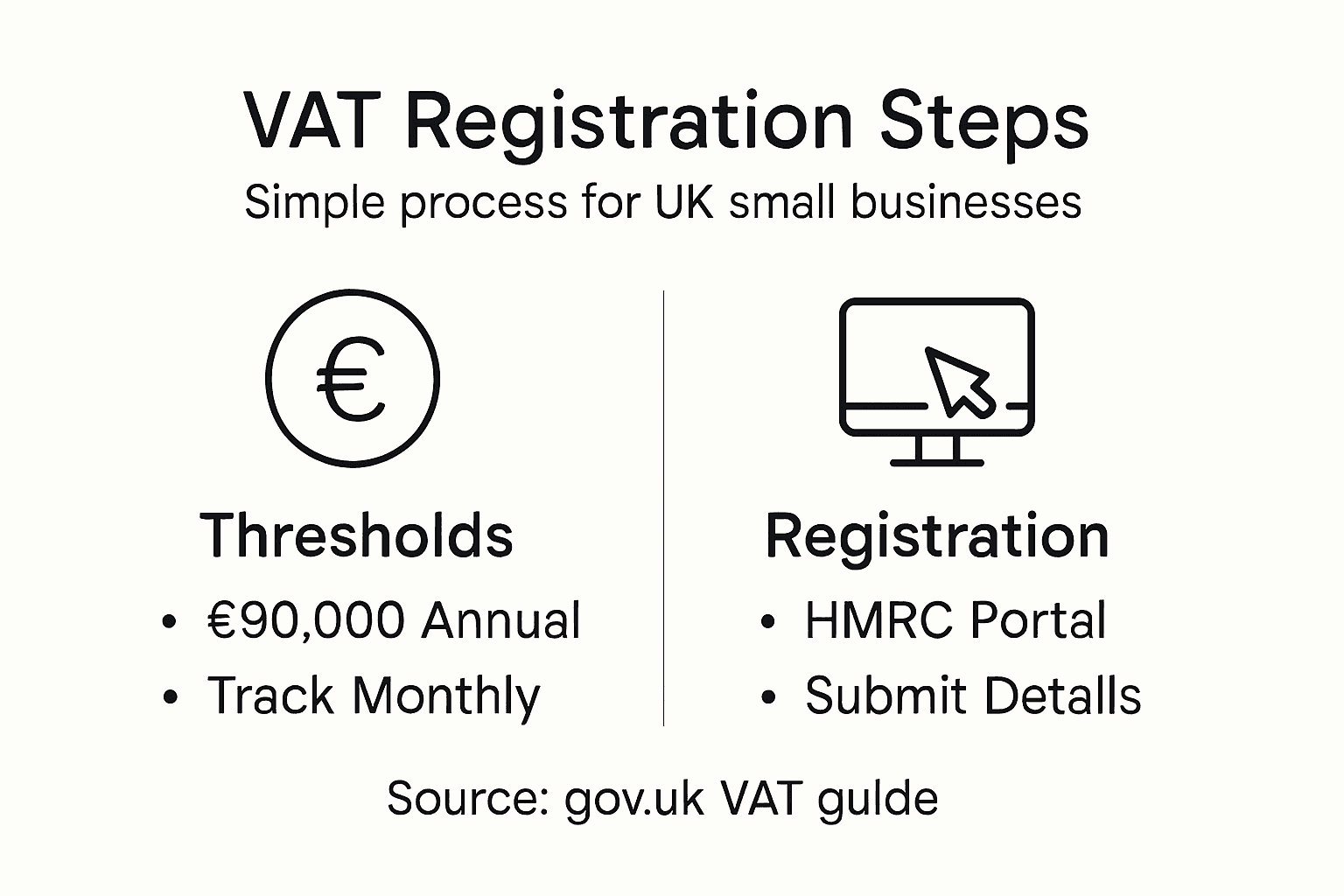
Pro tip: Maintain meticulous monthly financial records and set up alerts to track your approach to the VAT registration threshold.
How VAT Works for Small Businesses
Small businesses in the United Kingdom face unique challenges when navigating VAT regulations. VAT compliance involves complex considerations that can significantly impact a business’s financial strategy and operational decisions.
Key VAT mechanisms for small businesses include:
- VAT Charging: Adding VAT to sales invoices at appropriate rates
- VAT Reclaiming: Recovering VAT paid on business purchases
- Reporting: Submitting regular VAT returns to HMRC
- Threshold Management: Monitoring turnover to maintain compliance
The VAT system presents several critical implications for small businesses:
- Potential price increases after registration
- Administrative burden of VAT reporting
- Impact on competitiveness
- Cash flow considerations
Crossing the VAT threshold can create a significant operational and financial transition for small businesses.
To manage VAT effectively, many small businesses leverage simplified schemes like the Flat Rate Scheme, which allows for simplified VAT calculations and reduced administrative complexity. This approach can help businesses manage their tax obligations more efficiently while minimising accounting overhead.

Pro tip: Consider consulting a tax professional to develop a strategic approach to VAT management that aligns with your specific business model and growth objectives.
Obligations, Reporting and Digital Compliance
For VAT-registered businesses, navigating digital compliance has become increasingly complex in recent years. HMRC’s digital reporting requirements have fundamentally transformed how businesses manage their tax obligations.
Key VAT reporting obligations include:
- Accurate VAT record maintenance
- Quarterly digital VAT return submissions
- Timely tax payments
- Comprehensive financial documentation
The Making Tax Digital initiative has introduced several critical changes for businesses:
- Mandatory digital VAT return submissions
- Use of compatible accounting software
- Digital record-keeping requirements
- Real-time transaction tracking
Digital compliance is no longer optional – it’s a fundamental requirement for modern businesses.
Businesses must prepare for potential HMRC compliance checks by maintaining meticulous digital records. This involves not just storing documentation, but ensuring it is readily accessible, accurately categorised, and compatible with digital submission platforms.
Pro tip: Invest in cloud-based accounting software that automatically tracks VAT transactions and generates compliant digital reports to streamline your tax management process.
Here is a comparison of traditional vs digital VAT compliance approaches in the UK:
| Approach | Record Keeping | VAT Return Submission | Risk of Penalties |
|---|---|---|---|
| Manual | Paper-based records | Postal or online form | Higher due to errors |
| Digital (Making Tax Digital) | Cloud software, real-time tracking | Integrated digital platform | Lower; automated reminders help |
Common Pitfalls and Penalties to Avoid
Navigating VAT compliance requires meticulous attention to detail, as even small errors can result in significant financial consequences. VAT non-compliance penalties can be substantial for small businesses, making proactive management crucial.
Common VAT-related pitfalls include:
- Missing VAT registration deadlines
- Incorrectly calculating VAT rates
- Inadequate record-keeping
- Late VAT return submissions
- Inaccurate financial reporting
The potential penalties for VAT non-compliance are structured across several categories:
- Late registration penalties
- Inaccurate reporting fines
- Late payment surcharges
- Interest on outstanding tax
Small errors can quickly escalate into costly financial complications for unprepared businesses.
Businesses must implement robust internal processes to track VAT obligations systematically. This involves regular financial reviews, maintaining comprehensive digital records, and setting up automated reminders for critical deadlines.
Pro tip: Create a dedicated VAT compliance calendar with automated alerts to track registration thresholds, submission dates, and payment deadlines.
Take Control of VAT Challenges with Expert Guidance from KefiHub
Understanding VAT in the United Kingdom can feel overwhelming for small business owners. From navigating VAT registration thresholds to ensuring compliance with digital reporting requirements and avoiding costly penalties, the challenges are significant. If you are struggling with VAT obligations, managing taxable turnover, or applying the correct VAT rates, you are not alone. These are common pain points that demand reliable insights and practical advice.

At KefiHub, we provide clear and accessible support tailored for small businesses facing VAT complexities. Explore our dedicated resources to help you master VAT registration, compliance strategies and effective record-keeping. Don’t wait until deadlines become urgent or errors cause penalties. Visit KefiHub now to access expert commentary and real-world solutions that empower you to handle VAT confidently and protect your business growth. Take the next step towards VAT clarity and financial control by visiting KefiHub today.
Frequently Asked Questions
What is VAT and how does it work for small businesses?
VAT, or Value Added Tax, is a consumption tax applied to most goods and services sold by registered businesses. Small businesses must charge VAT on sales and can reclaim VAT on eligible purchases, but they must also submit regular VAT returns to HMRC.
What are the current VAT rates applicable in the UK?
The UK has three main VAT rates: the Standard Rate of 20% for most goods and services, a Reduced Rate of 5% for specific items like energy bills and child car seats, and a Zero Rate of 0% for essentials such as basic food and children’s clothing.
How does a small business register for VAT?
A small business must register for VAT with HMRC when its taxable turnover exceeds £90,000 in a 12-month period. The registration process includes calculating turnover, gathering necessary documentation, and completing an online registration.
What common mistakes should small businesses avoid regarding VAT compliance?
Common pitfalls include missing VAT registration deadlines, incorrectly calculating VAT rates, inadequate record-keeping, late VAT return submissions, and inaccurate financial reporting, all of which can result in penalties and fines.
Recommended
- Business Turnover Explained: Key Facts for UK Owners – Kefihub
- 7 Key Examples of Business Expenses for Small UK Firms – Kefihub
- Business Rates UK – How They Impact Small Firms – Kefihub
- Why Track Business Expenses: Financial Control UK – Kefihub
- Why SEO for Small Businesses: Complete Guide UK – Paul Baguley