


Running a small business in the United Kingdom comes with more digital rules than ever before. From data protection laws to the new Online Safety Act, even a simple business website must meet strict legal standards. Understanding what counts as website legal compliance can help you protect your company, avoid costly enforcement action, and build trust with your UK customers. This straightforward guide breaks down the essential steps you need to follow to keep your website both compliant and professional.
Table of Contents
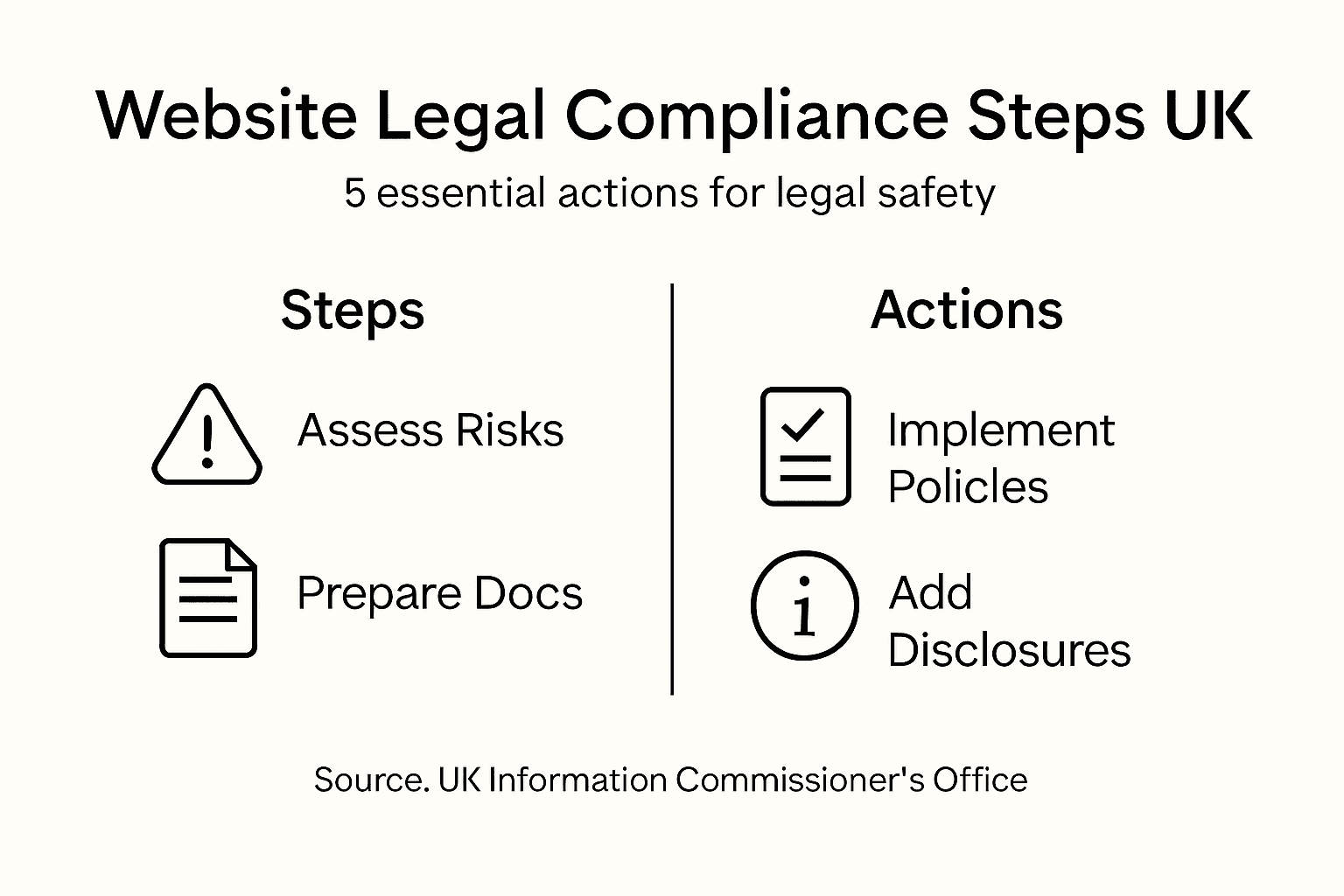
- Step 1: Assess Key Website Legal Obligations In The UK
- Step 2: Gather And Prepare Mandatory Compliance Documents
- Step 3: Implement Clear Privacy, Cookie And User Policies
- Step 4: Integrate Required Company And Trading Disclosures
- Step 5: Review And Test Compliance Across The Website
Quick Summary
| Key Point | Explanation |
|---|---|
| 1. Understand UK legal obligations | Assess your website against UK’s GDPR, Online Safety Act, and accessibility standards to ensure legal compliance. |
| 2. Prepare essential compliance documents | Create a Privacy Policy, Terms of Service, and other key documents that clearly outline user rights and data handling practices. |
| 3. Implement transparent user policies | Develop user consent, data transparency, and cookie management policies that communicate how user data is collected and handled. |
| 4. Display accurate trading disclosures | Provide your full business name, registration number, and contact information on your website to meet legal requirements. |
| 5. Regularly review compliance status | Conduct systematic checks on your website to identify legal vulnerabilities and maintain compliance with changing UK regulations. |
Step 1: Assess key website legal obligations in the UK
Understanding website legal compliance in the United Kingdom requires a systematic approach to protecting your online presence and user data. When operating a website targeting UK users, you must navigate complex legal requirements that span data protection, user safety, and digital accessibility.
To effectively assess your website’s legal obligations, focus on these critical areas:
- Data Protection: Comply with the UK General Data Protection Regulation (GDPR) and Data Protection Act 2018
- Online Safety: Meet requirements outlined in the Online Safety Act 2023
- User Consent: Implement transparent cookie policies and data collection practices
- Accessibility Standards: Ensure your website is accessible to users with disabilities
The legal landscape for UK websites involves multiple regulatory frameworks. Small business owners must carefully evaluate their digital platforms against specific online safety regulations, which now impose stringent requirements for protecting user information and managing digital content risks.

Your primary goal is developing a comprehensive understanding of legal expectations that apply to your specific website type, whether it’s an e-commerce platform, blog, or service-based site. This involves reviewing your current website practices against official UK guidelines and potentially consulting legal professionals who specialise in digital compliance.
To better understand which legal obligations apply to different website types in the UK, see this quick reference table:
| Website Type | Primary Legal Focus | Typical Compliance Challenges |
|---|---|---|
| E-commerce | GDPR, Online Safety Act, Trading | Checkout security, personal data handling |
| Blog | GDPR, Accessibility | Comment moderation, cookie transparency |
| Service Provider | GDPR, Trading Disclosures | Client data protection, business info visibility |
| Charity/Non-Profit | GDPR, Accessibility | Donation privacy, inclusive access |
Pro tip: Regularly review and update your website’s legal documentation to maintain ongoing compliance with evolving UK digital regulations.
Step 2: Gather and prepare mandatory compliance documents
Preparing your website’s legal documentation is a critical step in establishing robust legal compliance across the United Kingdom. This process involves systematically collecting and developing key documents that demonstrate your commitment to protecting user data, privacy, and digital safety.
Your essential compliance documentation should include:
- Privacy Policy: A comprehensive document explaining how you collect, use, and protect user data
- Terms of Service: Clear guidelines outlining user rights, website usage rules, and legal boundaries
- Cookie Consent Notice: Transparent information about tracking technologies used on your website
- Data Processing Agreement: Detailed explanation of how personal information is handled
- Accessibility Statement: Demonstrating your commitment to providing an inclusive digital experience
Comprehensive documentation is your first line of defence against potential legal challenges.
When developing these documents, consider working with a legal professional who specialises in digital compliance. Each document should be tailored to your specific business model, addressing the unique ways your website interacts with user data and online services.
Pay close attention to language clarity and transparency. Your documents should be written in plain English, avoiding complex legal jargon that might confuse users. Include specific details about data collection methods, user rights, and the mechanisms users can employ to manage their personal information.
Pro tip: Review and update your compliance documents at least annually to ensure they reflect current UK digital regulations and your evolving business practices.
Step 3: Implement clear privacy, cookie and user policies
Creating transparent and comprehensive privacy, cookie, and user policies is fundamental to establishing trust and legal compliance for your UK website. These policies serve as critical communication tools that inform users about how their data is collected, processed, and protected.
When developing your policies, focus on the following key components:
- User Consent: Obtain explicit permission for data collection
- Data Transparency: Clearly explain what information you collect
- Purpose Limitation: Specify exact reasons for data processing
- User Rights: Outline methods for data access, correction, and deletion
- Cookie Management: Provide clear options for cookie preferences
Transparency builds user trust and demonstrates your commitment to ethical data practices.
The Information Commissioner’s Office guidelines recommend creating policies that are easily understandable, avoiding complex legal language. Your documentation should be written in plain English, ensuring that users can quickly comprehend how their personal information will be handled.
Implement a user-friendly consent mechanism that allows individuals to understand and control their data preferences. This might include granular cookie consent options, clear opt-out procedures, and straightforward mechanisms for requesting personal data information or deletion.
Pro tip: Consider using visual aids like flowcharts or icons to make your privacy policies more engaging and easier to understand for users with varying levels of digital literacy.
Step 4: Integrate required company and trading disclosures
Ensuring your website displays accurate company information is a legal requirement for UK businesses. Proper trading disclosures protect both your business and your customers by providing transparency about your legal identity and operational status.
Your essential trading disclosure requirements include:
- Company Name: Full registered business name
- Company Number: Registration details from Companies House
- Registered Office Address: Official business location
- VAT Registration: If applicable, display VAT number
- Contact Information: Clear methods for customer communication
Trading disclosures are not optional – they are a legal necessity for UK businesses.
Trading disclosure regulations mandate specific details that must be prominently displayed across your digital and physical business platforms. This means your website should include a dedicated section that comprehensively outlines your company’s legal standing.
Pay particular attention to displaying your company registration number, registered office address, and other key identifiers. These details should be easily accessible, typically located in the website footer or a dedicated ‘About Us’ or ‘Legal’ page. Ensure the information matches exactly with your official Companies House registration to maintain legal compliance.
Pro tip: Create a standardised template for your trading disclosures that can be easily updated across all your digital platforms, ensuring consistent legal compliance.
Step 5: Review and test compliance across the website
Comprehensively reviewing and testing your website’s legal compliance is a critical final step in ensuring your digital platform meets all UK regulatory requirements. This process involves systematically examining every aspect of your website to identify and rectify potential legal vulnerabilities.
Your compliance review should encompass the following key areas:
- Cookie Consent: Verify consent mechanisms and user controls
- Privacy Policy: Check for comprehensive and clear information
- Data Processing: Confirm transparency in data collection practices
- User Rights: Test mechanisms for data access and deletion requests
- Trading Disclosures: Validate accuracy of company information
A thorough compliance review is your best defence against potential legal challenges.
The Information Commissioner’s Office recommends regular compliance testing to ensure ongoing legal adherence. Consider conducting both automated and manual reviews, paying close attention to how different user interactions might expose potential compliance gaps.
Engage multiple team members or consider hiring an external compliance specialist to conduct an independent review. This approach provides an objective assessment of your website’s legal standing, helping you identify any subtle issues that might have been overlooked during initial development.
Here is a summary of common legal compliance mistakes and their potential impact on UK websites:
| Mistake | Potential Impact | Best Solution |
|---|---|---|
| Vague privacy policy | Loss of user trust, ICO fines | Use clear, plain English |
| Missing trading disclosures | Legal penalties, less business credibility | Standardised template, regular audits |
| Weak cookie consent | User complaints, regulatory scrutiny | Granular controls, regular updates |
| Outdated compliance documents | Missed new legal requirements | Annual professional review |
Pro tip: Create a comprehensive compliance checklist that you can use for quarterly reviews, ensuring your website remains up-to-date with the latest legal requirements.
Ensure Your UK Website Meets Every Legal Requirement with Confidence
Navigating the maze of UK website legal compliance can feel overwhelming. From GDPR data protection to clear cookie policies and mandatory trading disclosures, small business owners and service providers face critical challenges in keeping their websites legally secure. This guide highlights essential steps like crafting transparent privacy policies and thorough compliance testing to avoid costly fines and build trust with your users.
Explore our Legal Archives – Kefihub for expert insights tailored to UK professionals. Take control today by visiting KefiHub to access clear, practical advice and resources designed to help you confidently implement legal safeguards on your digital platform. Don’t wait until compliance issues impact your business—start improving your website’s legal framework now and stay ahead of evolving regulations with support from our comprehensive Digital Archives – Kefihub.
Frequently Asked Questions
What are the key legal obligations for my website in the UK?
To ensure compliance, your website must adhere to the UK General Data Protection Regulation (GDPR), the Online Safety Act, and data accessibility standards. Start by reviewing your data protection practices and ensuring all user consent mechanisms are clear and transparent.
How can I create a compliant privacy policy for my website?
A compliant privacy policy should clearly outline how you collect, use, and protect user data. Draft this document in plain English and include explicit details about user rights and how they can manage their personal information.
What should I include in my cookie consent notice?
Your cookie consent notice must provide clear information about tracking technologies on your website and obtain explicit user consent before collecting data. Outline what cookies are used, their purpose, and give users the option to manage their preferences easily.
How often should I review my website’s legal compliance?
It is advisable to review your website’s legal compliance at least annually or whenever there are significant changes to your business practices. Schedule a compliance audit to ensure all legal documents are up-to-date and reflect current regulations.
What are the potential consequences of not complying with UK website regulations?
Failure to comply with UK regulations can result in hefty fines, legal challenges, and loss of user trust. To mitigate these risks, implement a comprehensive compliance checklist and update your policies regularly to align with legal standards.
How can I incorporate proper trading disclosures on my website?
Include your company’s full registered name, registration number, registered office address, VAT number, and contact information prominently on your website. These details should typically be located in the footer or on a dedicated "About Us` page.
Recommended
- 7 Steps to a Robust Legal Compliance Checklist for UK SMEs – Kefihub
- Business Registration Step by Step for UK Owners – Kefihub
- How to Optimise Professional Website for UK SMEs – Kefihub
- Why Build a Website: Boosting UK Small Businesses – Kefihub