

Market shocks and shifting regulations have caught many UK small business owners off guard, often with little warning and no internal teams to fall back on. For SMEs, building business resilience is not just about weathering the next storm, but about making decisions today that protect tomorrow’s cashflow and reputation. This guide lays out practical steps and habits to strengthen your business, giving you clarity on financial, operational, and legal priorities when resources are stretched thin.
Table of Contents
- Defining Business Resilience For SMEs
- Core Types: Financial, Operational, Strategic
- Legal Duties And Regulatory Expectations
- Building Resilience: Effective Tools And Habits
- Common Pitfalls And Risk Mitigation
Key Takeaways
| Point | Details |
|---|---|
| Understand Business Resilience | Resilience is not just surviving crises but thriving amidst them, requiring preparation and adaptability for SMEs. |
| Focus on the Three Pillars | Financial, operational, and strategic resilience are vital for SMEs; each pillar addresses different vulnerabilities that require tailored action plans. |
| Legal Obligations | SMEs must recognise the growing legal expectations for resilience, necessitating documentation of risk assessments and preparedness strategies. |
| Build Resilience Habits | Implement practical daily habits that enhance resilience, such as financial tracking and regular scenario planning, to strengthen your business against disruptions. |
Defining Business Resilience For SMEs
Business resilience for small and medium-sized enterprises (SMEs) is fundamentally about your ability to absorb shocks, adapt quickly, and continue operating when market disruptions occur. It is not merely about surviving a crisis, but about bouncing back stronger and positioning your business to thrive despite external pressures. For UK SMEs operating with limited resources and lean teams, resilience represents a strategic advantage that distinguishes businesses that fold from those that endure.
Understanding what resilience actually means in practice requires moving beyond theoretical definitions. Research on SME resilience during crises identifies that resilient businesses share specific traits and coping strategies that enable them to withstand shocks. These include financial flexibility, adaptable operational processes, strong stakeholder relationships, and leadership that responds decisively to change. For your business, this translates into concrete actions: maintaining cash reserves for unexpected events, building supplier relationships beyond single-source dependencies, cross-training staff so operations don’t collapse if key people leave, and staying informed about market trends that could affect your sector.
What makes resilience particularly complex for SMEs is that you operate under constant tension between stability and adaptability. You need enough structure to maintain consistent customer service and financial controls, yet enough flexibility to pivot when market conditions shift. A manufacturing business relying on European supply chains cannot simply ignore geopolitical tensions. A digital services firm must anticipate skills gaps before they become operational bottlenecks. A hospitality venue needs contingency planning for unexpected closures, whether from staffing issues or external disruptions. The specific components of resilience vary by industry and business model, but the underlying principle remains: anticipate what could go wrong, prepare responses in advance, and build your team’s capability to execute those responses under pressure.
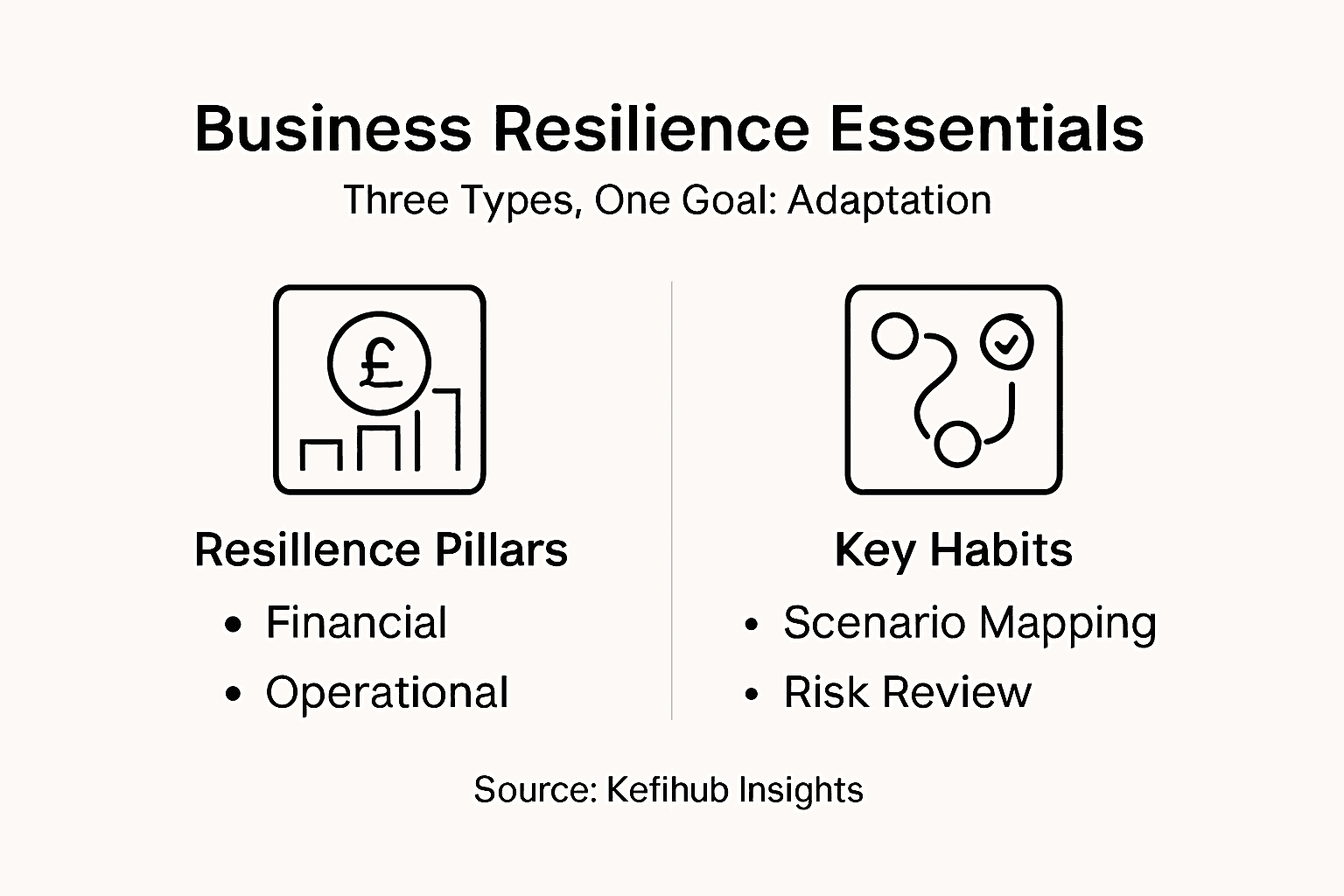
Resiliency frameworks for SMEs typically rest on three pillars: preparatory attributes (financial reserves, diversified income streams, strong governance), crisis awareness (monitoring risks specific to your sector), and adaptive capacity (your ability to make quick decisions and implement changes). Unlike larger corporations with dedicated risk management departments, you must integrate resilience thinking into your everyday operations and decision making.
Here is a concise comparison of the three pillars of SME business resilience and typical signs of weakness for each:
| Resilience Pillar | Essential Attribute | Example of Weakness | Business Consequence |
|---|---|---|---|
| Financial | Cash reserves | No emergency fund | Inability to handle revenue dip |
| Operational | Staff cross-training | Single skilled employee | Service disruption if departure |
| Strategic | Market trend monitoring | Reactive leadership | Missed emerging opportunities |
Professional tip: Map three realistic scenarios that could disrupt your business within the next 12 months, then identify one concrete action for each scenario you could implement this month to reduce vulnerability.
Core Types: Financial, Operational, Strategic
Business resilience isn’t a single monolithic concept. It operates across three distinct but interconnected dimensions, each addressing different vulnerabilities your business faces. Understanding these types helps you prioritise where to invest time and resources, especially when your budget is tight and your team wears multiple hats. Business resilience integrates operational, organisational, and strategic dimensions, creating a comprehensive approach that addresses how your business survives disruptions.

Financial Resilience
Financial resilience is your first line of defence when shocks hit. This means having enough cash reserves to weather unexpected revenue drops, managing debt responsibly so you aren’t crushed by repayments during downturns, and diversifying income streams so one lost client doesn’t threaten survival. For a UK SME, this typically means holding three to six months of operating expenses in accessible reserves, though this varies by industry volatility. It also includes managing your exposure to financial risks: not overextending on equipment leases, spreading supplier payments so you don’t face cashflow cliffs, and understanding your break-even point so you know exactly how much revenue you need to stay operational. During the pandemic, businesses with strong financial reserves adapted faster because they could invest in pivots without immediate survival pressure.
Operational Resilience
Operational resilience ensures your day-to-day business functions continue despite disruptions. This covers everything from supply chain redundancy (not relying on a single supplier who might disappear overnight) to process documentation (so anyone on your team can step in if someone falls ill unexpectedly) to technology backup systems (so a server failure doesn’t wipe out your customer data). It includes staff cross-training, so key functions don’t collapse if your experienced technician or manager leaves. Operational resilience also means building agility into how you work, so your team can respond quickly to changed circumstances without lengthy approval chains.
Strategic Resilience
Strategic resilience is your ability to anticipate market shifts and position your business ahead of change. This involves leadership that actively scans the horizon for emerging threats and opportunities, a culture where staff feel empowered to suggest improvements without fear of punishment, and investment in innovation so you’re not blindsided by new competitors or technologies. It’s about asking difficult questions: Could a new regulation reshape your sector? Are customer preferences shifting? Is your pricing sustainable long-term? Strategic resilience prevents you from optimising so heavily for today’s market that you become irrelevant tomorrow.
Professional tip: Audit your business this week by rating yourself on each dimension (financial, operational, strategic) on a scale of one to five, then focus your first resilience efforts on whichever dimension scored lowest.
Legal Duties And Regulatory Expectations
Whilst business resilience might sound like an optional nice-to-have, the UK regulatory landscape increasingly treats it as a legal obligation. You’re not required to achieve perfect resilience, but you are expected to demonstrate that you’ve thought about what could go wrong, planned accordingly, and put systems in place to respond. This applies differently depending on your sector, your size, and whether you handle sensitive customer data or financial information. The principle is straightforward: regulators want to see that you take risks seriously and have governance structures in place to manage them.
For most UK SMEs, resilience duties flow through sector-specific regulations rather than a single overarching law. If you operate in financial services, even as a small advisor or payments processor, you face stringent requirements around operational continuity. The UK financial regulators introduced new rules in 2024 targeting resilience of critical third-party service providers, which means if you provide technology or support services to financial firms, you must demonstrate robust governance, documented risk management processes, incident response plans, and regular testing of your systems. The Financial Conduct Authority takes this seriously and actively reviews compliance. If you handle personal data under the Data Protection Act 2018 or UK GDPR, you must implement measures to ensure data security and availability, which inherently requires resilience thinking around your IT systems and data backups. Health and safety regulations require you to identify hazards and put controls in place, which is essentially resilience for workplace risks. Environmental regulations increasingly require businesses to assess climate-related risks to their operations.
What this means practically is that your legal duty isn’t to prevent all disruptions, but to demonstrate thoughtful preparation. You need to document what you’ve considered as potential threats, explain why you’ve chosen particular safeguards, maintain records of testing or reviews, and show you can adapt if something goes wrong. This documentation becomes critical if a regulator investigates, an insolvency occurs, or a customer sues following a service failure you should have anticipated.
Below is a quick reference summary showing how key UK regulations impact SME resilience planning:
| Regulation Area | Primary Requirement | Affects Which SMEs | Practical Impact |
|---|---|---|---|
| Financial Conduct | Incident response plans | Financial service firms | Mandates robust crisis systems |
| Data Protection (GDPR) | Data availability and security | All with personal data | Necessitates backups in IT systems |
| Health & Safety | Hazard controls in workplace | All with premises/staff | Requires physical risk assessment |
| Environmental | Climate risk assessment | Manufacturing, supply chain | Compels review of physical threats |
Professional tip: Contact your sector’s trade body or regulator’s website this week to identify which specific resilience requirements apply to your business, then create a simple one-page document listing those requirements and your current status against each one.
Building Resilience: Effective Tools And Habits
Building resilience isn’t a one-time project you complete and then forget about. It’s a collection of practical habits and tools you embed into how your business operates daily. The difference between businesses that collapse under pressure and those that adapt lies largely in the systems and mindsets they’ve cultivated beforehand. You don’t need expensive software or consultants to start. You need clarity about what matters, regular conversations with your team, and willingness to test your assumptions before a crisis forces you to.
Strategies to enhance resilience include developing precautionary measures such as financial management, sustainability initiatives, and adaptive capacities which stabilise your firm and enable growth after disruptions. This translates into concrete practices for your SME:
- Financial management: Track your cash position weekly, not monthly. Know your burn rate and survival runway. Build a small emergency fund before you need it, even if it’s just one month’s operating costs to start.
- Scenario planning: Spend an afternoon quarterly imagining three credible disruption scenarios specific to your sector. What would you do if your main supplier vanished? If a key customer left? If your premises became inaccessible? Document rough response plans.
- Workforce development: Cross-train people so multiple staff members can handle critical functions. Document how you actually do things, not just what should happen in theory. Invest in staff skills that make them more adaptable to change.
- Technology adoption: Automate routine tasks where feasible so your team has capacity for problem-solving during disruptions. Cloud-based systems reduce dependency on single physical locations.
Equally important is building the right mindset. Building resilience starts with leadership and mindset, emphasising mental well-being, open communication, and collaborative decision-making. This means creating psychological safety so staff feel comfortable raising problems early rather than hiding them until they explode. It means you as a leader demonstrating calmness under pressure, asking for input before making big decisions, and treating setbacks as learning opportunities rather than failures to punish. When your team knows you’ll listen and adapt based on what they tell you, they become your early warning system.
Professional tip: Pick one resilience habit this month and build it into your weekly routine: reviewing cash position, holding a 30-minute team discussion about current operational risks, or documenting one critical business process.
Common Pitfalls And Risk Mitigation
Most UK SMEs understand intellectually that they should prepare for disruptions. The gap between understanding and action is where most businesses stumble. You likely know you should have cash reserves, but cash is tight so you spend it. You know you should document processes, but your team is stretched thin delivering client work. You recognise single points of failure in your supply chain, but switching suppliers costs money and effort you don’t have budget for right now. These aren’t character flaws. They’re the predictable tensions small business owners navigate constantly.
The critical mistake is treating resilience as something you’ll address when business slows down. That day rarely comes. SMEs often confront limited financial resources, inadequate crisis preparedness, and reliance on external funding which inhibit resilience, creating a vicious cycle where the businesses most vulnerable to shocks have the least capacity to prepare for them. Another common pitfall is underestimating how complex a genuine crisis actually is. You plan for one scenario (a key staff member leaving, a major client cancelling), then a crisis hits that combines three unexpected challenges simultaneously. Your carefully prepared response becomes useless because it doesn’t match reality. This is why effective risk mitigation involves identifying risks, assessing their probability and impact, and implementing controls to lower exposure rather than trying to predict exact scenarios.
Here’s what actually works. Start by identifying your highest-impact vulnerabilities, not all possible risks. A hospitality business’s greatest risk might be losing its premises or key staff. A digital agency’s risk might be data loss or key client concentration. List three to five realistic scenarios that would genuinely hurt your business if they occurred, then ask for each one: what’s the minimum I need in place to survive this? For financial vulnerabilities, even modest cash reserves (one month of operating costs) make an enormous difference. For operational vulnerabilities, basic documentation and cross-training prevent collapse. For reputational risks, having incident response plans and clear communication templates prepared in advance lets you respond faster. You’re not trying to prevent every possible problem. You’re reducing exposure to the most damaging ones.
Professional tip: Conduct a rapid risk assessment this week: list your top three business vulnerabilities, rate each as high, medium, or low impact, then implement one small control for whichever risk has the highest impact and is easiest to address.
Strengthen Your Business Resilience with KefiHub Insights
Navigating market shocks and building true business resilience require clear strategies and practical steps. This article highlights critical challenges such as maintaining financial reserves, cross-training staff, and anticipating market shifts. At KefiHub, we understand these pain points and provide you with expert guidance tailored for UK SMEs who want to not only survive but thrive. Discover actionable advice on financial, operational, and strategic resilience designed to help you prepare for uncertainties with confidence.
Explore our comprehensive Business Archives – Kefihub to access detailed insights and real-world solutions. Take control of your resilience planning today and gain the tools needed to adapt swiftly when disruptions arise. Visit KefiHub now for reliable, practical guidance that supports your business at every step.
Frequently Asked Questions
What is business resilience for SMEs?
Business resilience for SMEs refers to their ability to absorb shocks, adapt to market disruptions, and continue operations effectively. It involves not just surviving crises, but also bouncing back stronger and maintaining a competitive edge.
What are the key pillars of business resilience?
The three key pillars of business resilience are: financial resilience (holding cash reserves and managing debt), operational resilience (ensuring continuity in day-to-day functions), and strategic resilience (anticipating market shifts and positioning the business accordingly).
How can SMEs prepare for potential disruptions?
SMEs can prepare for disruptions by maintaining cash reserves, establishing strong supplier relationships, cross-training staff, and regularly monitoring market trends. Additionally, developing scenario plans can help in anticipating and responding to unexpected challenges.
What legal duties do SMEs have regarding business resilience?
SMEs must demonstrate thoughtful preparation for potential disruptions, which varies by sector. This includes having incident response plans, ensuring data security and availability, conducting risk assessments, and complying with health and safety regulations.
Recommended
- How to Avoid Common Business Mistakes for UK Professionals – Kefihub
- Why Update Your Business Plan – Staying Relevant in 2025 – Kefihub
- Business Insurance Explained: Key Roles for UK Companies – Kefihub
- Role of Business Consultant: Impact on UK SMEs – Kefihub
- Sales Business Development Manager: Driving Growth in UK Tech