


Most British business owners are surprised to learn that over half of small companies fail to plan for leadership transitions, leaving continuity at risk. For British firms with just a handful of employees, the sudden departure of a key leader can threaten jobs, morale, and business reputation. This guide explains the critical principles behind business succession, helping you position your company for smooth change while addressing the legal and financial considerations unique to the British market.
Table of Contents
- What Is Business Succession? Core Principles
- Common Succession Types and Approaches
- How The Business Succession Process Works
- UK Legal Framework and Owner Obligations
- Risks, Costs, and Tax Implications
Key Takeaways
| Point | Details |
|---|---|
| Importance of Business Succession | Business succession is a continuous process essential for maintaining organisational stability and performance during leadership transitions. |
| Diverse Succession Strategies | Various succession types exist, including internal family succession and management buyouts, each carrying distinct implications for culture and stakeholder relations. |
| Structured Succession Process | A clear and structured approach comprising assessment, candidate identification, development, and planning is crucial for successful leadership transitions. |
| Legal and Financial Considerations | Proactive legal planning and understanding financial risks, such as inheritance and capital gains taxes, are vital to ensuring smooth business transitions. |
What Is Business Succession? Core Principles
Business succession represents a strategic process that enables organisations to manage leadership transitions smoothly and sustainably. At its core, business succession involves identifying, developing, and positioning future leaders to maintain organisational continuity and performance. The Harvard Business School research highlights that this is not merely a one-time event, but a continuous, organisation-wide strategy deeply connected to leadership development and corporate growth.
The fundamental principles of business succession extend beyond simply replacing a departing leader. Instead, it encompasses a comprehensive approach that integrates talent development, strategic planning, and organisational resilience. Systematic literature reviews from academic research reveal that successful succession involves multiple critical dimensions:
- Proactive identification of potential leadership candidates
- Structured leadership development programmes
- Clear governance frameworks
- Transparent transition mechanisms
- Alignment with long-term strategic objectives
Particularly for small UK businesses, succession planning is not a luxury but a necessity. The process requires careful consideration of individual skills, organisational culture, and future strategic directions. Business owners must think beyond immediate replacements and focus on cultivating leadership capabilities that can adapt to evolving market challenges.
Pro Tip for Business Owners: Create an internal talent pipeline by implementing mentorship programmes and providing strategic development opportunities for promising employees, ensuring a smooth and predictable leadership transition when the time comes.
Common Succession Types and Approaches
Business succession strategies are not one-size-fits-all, but rather a nuanced landscape of potential approaches tailored to organisational needs. Comprehensive research comparing succession strategies identifies several fundamental succession types that businesses can consider:
- Internal Family Succession: Transferring leadership within the same family lineage
- Management Buyout: Current management team purchasing ownership
- External Sale: Selling the business to an outside party
- Strategic Merger: Combining with another organisation to facilitate leadership transition
- Professional External Recruitment: Bringing in new leadership from outside the current organisational structure
Academic research highlights that each succession approach carries unique implications for organisational culture, stakeholder relationships, and long-term strategic continuity. For small UK businesses, the choice depends on multiple factors including company size, industry dynamics, existing talent pool, and ownership structure.
The selection process demands careful evaluation of potential candidates’ capabilities, alignment with organisational values, and capacity to drive future growth. Successful transitions require transparent communication, structured development programmes, and a forward-looking perspective that extends beyond immediate leadership replacement.
Here’s how common business succession types compare in key areas:
| Succession Type | Typical Transition Speed | Cultural Continuity Impact | Risk of Stakeholder Disruption |
|---|---|---|---|
| Internal Family Succession | Slow to moderate | High | Low to moderate |
| Management Buyout | Moderate | Moderate | Moderate |
| External Sale | Fast | Low | High |
| Strategic Merger | Variable | Moderate | High |
| Professional External Recruitment | Moderate | Low to moderate | Moderate to high |
Pro Tip for Business Owners: Conduct a comprehensive skills audit and personality assessment of potential successors, ensuring they not only possess technical competencies but also demonstrate the emotional intelligence and strategic thinking required to navigate complex business challenges.
How the Business Succession Process Works
Comprehensive research on business succession methodologies reveals a structured approach that transforms leadership transitions from potential disruptions into strategic opportunities. The process typically unfolds through several interconnected stages, each requiring meticulous planning and careful execution.
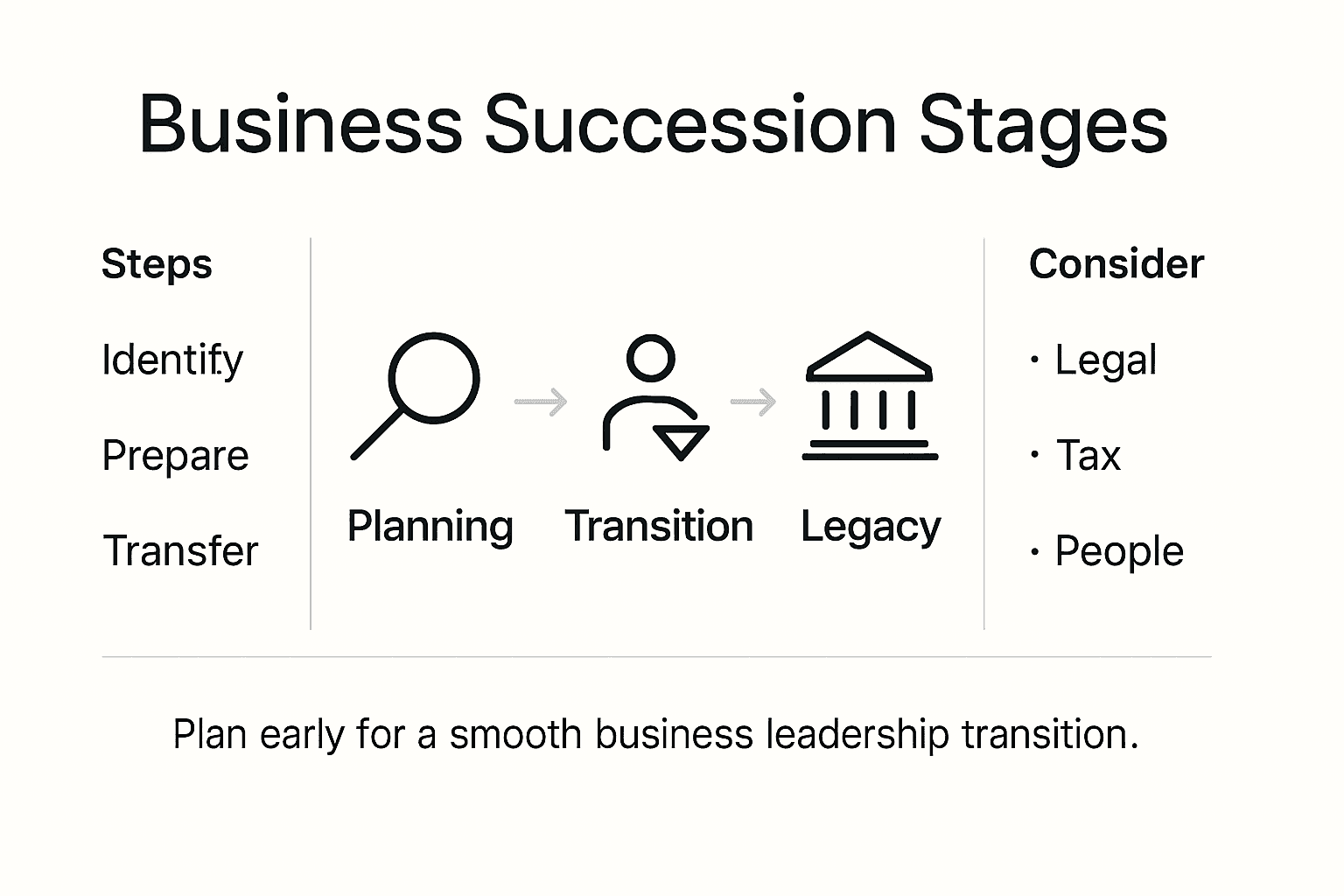
The succession process can be broken down into key stages:
- Initial Assessment
- Evaluate current leadership capabilities
- Identify potential succession gaps
- Understand organisational strategic objectives
- Candidate Identification
- Map internal talent pool
- Define critical leadership competencies
- Assess potential successors’ skills and potential
- Development and Preparation
- Design targeted training programmes
- Create mentorship opportunities
- Provide strategic exposure to key business functions
- Transition Planning
- Develop detailed transition roadmaps
- Establish clear handover mechanisms
- Create support structures for incoming leadership
Bibliometric research on succession planning emphasises that successful transitions are not about abrupt changes, but carefully orchestrated processes that maintain organisational stability and momentum. Each stage requires transparent communication, stakeholder engagement, and a forward-looking perspective that balances immediate operational needs with long-term strategic vision.

For small UK businesses, the succession process demands flexibility and personalisation. While the fundamental stages remain consistent, the implementation must be tailored to each organisation’s unique culture, size, and strategic goals. The objective is not merely to replace a leader, but to ensure continuous leadership excellence and sustainable business performance.
Pro Tip for Business Owners: Create a comprehensive ‘leadership blueprint’ documenting critical knowledge, relationship networks, and strategic insights, ensuring that institutional wisdom is systematically transferred during leadership transitions.
UK Legal Framework and Owner Obligations
Legal considerations for business succession constitute a complex landscape that demands careful navigation by UK business owners. The legal framework surrounding business succession involves multiple critical documentation requirements and strategic considerations that protect both the business and its stakeholders.
Key legal obligations for business owners include:
- Articles of Association: Defining ownership structure and transfer mechanisms
- Shareholders’ Agreements: Establishing clear rules for ownership transitions
- Cross-Option Agreements: Creating predetermined buyout mechanisms
- Inheritance Tax Planning: Managing potential tax implications of business transfer
- Corporate Governance Documentation: Maintaining transparent transition protocols
The legal complexity varies significantly depending on business structure. Sole traders face different requirements compared to limited companies or partnerships, with each structure demanding unique documentation and compliance strategies. Limited companies, for instance, require more comprehensive documentation to ensure smooth leadership and ownership transitions.
The table below summarises unique legal considerations by business structure in the UK:
| Business Structure | Key Succession Document | Principal Legal Challenge |
|---|---|---|
| Sole Trader | Will or partnership deed | Owner’s death halting continuity |
| Partnership | Partnership agreement | Clarifying partner exit procedures |
| Limited Company | Articles of association | Coordinating shareholder transitions |
| Family Business | Cross-option agreement | Balancing family and business needs |
British legal frameworks emphasise the importance of proactive planning. Business owners must anticipate potential scenarios, draft comprehensive agreements, and ensure all stakeholders understand their rights and responsibilities during succession. This involves not just legal paperwork, but also strategic considerations about business continuity, stakeholder interests, and long-term organisational stability.
Pro Tip for Business Owners: Engage a specialised commercial solicitor to review and draft your succession documents, ensuring they are legally robust, cover all potential scenarios, and align with your specific business structure and strategic objectives.
Risks, Costs, and Tax Implications
Global tax research on business succession reveals a complex landscape of financial risks that can significantly impact business transfers. UK business owners must navigate a minefield of potential tax exposures, inheritance complications, and strategic financial challenges during leadership transitions.
Key financial risks and considerations include:
- Inheritance Tax Exposure: Potential significant tax liabilities on business asset transfers
- Capital Gains Tax: Potential taxation on increased business value during transition
- Valuation Challenges: Complex methods for determining business worth
- Forced Sale Risks: Potential liquidation due to tax or legal complications
- Cross-Border Transfer Complexities: Additional tax implications for international business structures
Academic analysis of inheritance taxation demonstrates that poorly managed succession can dramatically reduce business value. Small UK businesses face particularly challenging scenarios where tax burdens might consume substantial portions of business equity. The financial impact extends beyond immediate taxation, potentially affecting long-term business sustainability and operational continuity.
Understanding these risks requires a strategic approach that integrates financial planning, legal consultation, and proactive tax management. Business owners must anticipate potential tax scenarios, explore relief mechanisms like business property relief, and develop comprehensive strategies that minimise financial strain during leadership transitions.
Pro Tip for Business Owners: Engage a specialist tax advisor at least 18 months before planned succession to develop a comprehensive tax mitigation strategy, potentially saving significant resources and preserving business value during ownership transfer.
Secure Your Business Future with Expert Succession Guidance
Business succession is a critical challenge for many UK small business owners seeking to ensure smooth leadership transitions, protect their business equity, and navigate complex legal frameworks. If you feel overwhelmed by succession planning, inheritance tax implications, or identifying the right leadership candidates, you are not alone. Understanding the importance of proactive identification, clear governance, and legal documentation can be the difference between organisational continuity and disruptive change.
At KefiHub, we offer clear, reliable and practical guidance designed to empower you at every step of your succession journey. From grasping the essentials of business succession to navigating ownership transfers within the UK legal landscape, our platform delivers expert advice tailored for today’s UK professionals.
Don’t leave the future of your business to chance. Visit KefiHub now to access actionable strategies and expert insights that will help you build a resilient leadership pipeline, understand legal obligations, and plan tax-efficient transitions. Take control of your business succession today with trusted knowledge at your fingertips.
Frequently Asked Questions
What is business succession?
Business succession refers to the strategic process of managing leadership transitions within an organisation, focusing on identifying, developing, and positioning future leaders to ensure organisational continuity and performance.
Why is business succession planning essential for small businesses?
Business succession planning is crucial for small businesses as it ensures a smooth transition of leadership, preserves organisational culture, and maintains stakeholder confidence, which are vital for sustaining business operations and growth.
What are the main types of business succession strategies?
Common types of business succession strategies include internal family succession, management buyouts, external sales, strategic mergers, and professional external recruitment, each tailored to an organisation’s unique needs.
What are the key stages involved in the business succession process?
The key stages of the business succession process include initial assessment, candidate identification, development and preparation, and transition planning, each designed to facilitate a smooth and effective leadership transition.
Recommended
- Role of Business Mentors: Impact on UK Business Success – Kefihub
- Complete Guide to Why Incorporate a Business – Kefihub
- Why Sustainable Business: Complete Guide for UK Professionals – Kefihub
- Why Sustainable Business: Complete Guide for UK Professionals – Kefihub
- Why Website Structure Matters for Business Growth – ResponsiveWebsiteDesign